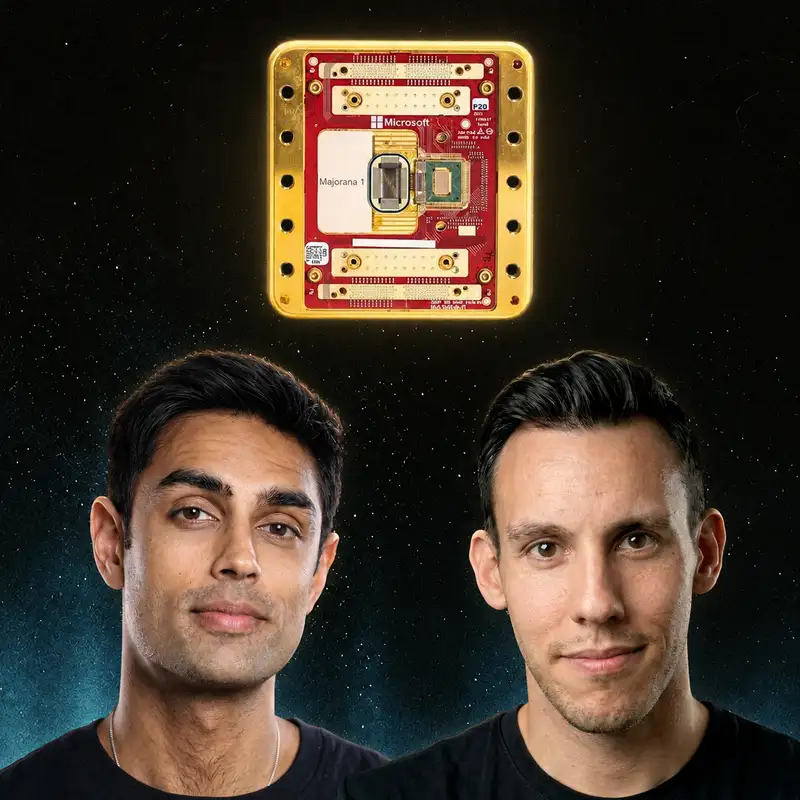
The Quantum Computing Moment: The Last Tech Frontier
Josh:
I came across this post that asked the question, what comes after AI?
Josh:
And I was thinking to myself, AI has been my entire universe for a long time.
Josh:
What does actually come afterwards? And I thought robotics, we have space.
Josh:
We also have this thing called quantum computing. And I was like,
Josh:
huh, it's been a while since we've talked about quantum computing.
Josh:
What's going on there? It turns out the answer is quite a bit,
Josh:
starting with the president of the United States who just signed two executive orders,
Josh:
accelerating the rate of progress that we have around quantum computing,
Josh:
as well as personally taking the balance sheet of the United States of America
Josh:
and using it to invest privately in a few of these quantum companies.
Josh:
So this episode, we're going to unpack the quantum opportunity,
Josh:
what's going on, give you an update on the state of things, as well as where
Josh:
you can find optimal places to put your money in the case that you are bullish
Josh:
on quantum as a category and you think it is going to be one of the next upcoming trends.
Josh:
This, of course, none of this will be financial advice, although if you've been
Josh:
copy trading the president of the United States for a while,
Josh:
you've been doing pretty damn good. So that's what compelled us to want to make
Josh:
this episode. We were personally curious, and hopefully this curiosity can be
Josh:
shared with you guys who are listening and you can get something pretty positive out of it.
Ejaaz:
You know, it's so interesting. I've always thought of the United States government
Ejaaz:
as being like a customer of innovation.
Ejaaz:
So like they buy the rockets, they buy the weapons, they invest in the labs,
Ejaaz:
but they never actually take like an equity upside in any of these companies.
Ejaaz:
And recently they've been doing that with AI and now they're doing it with a
Ejaaz:
new technology, which is not technically new, but is coming into its kind of
Ejaaz:
like chat GPT type moment, which is quantum technology itself.
Ejaaz:
They signed two executive orders yesterday. One is focusing or directing federal
Ejaaz:
agencies to work very closely with the companies that are building this new
Ejaaz:
quantum technology, work with the academics and understand how this works with
Ejaaz:
the sole goal of building a quantum computer
Ejaaz:
by 2028, which supposedly is going to solve all our problems.
Ejaaz:
And then order number two is directing all the agencies, the governments,
Ejaaz:
the companies that exist and run the world today and the country of the United
Ejaaz:
States of America to harden their systems against potential quantum attacks.
Ejaaz:
Quantum computers, as we're going to explain in a short second,
Ejaaz:
could be used very maliciously if placed in the wrong hands.
Ejaaz:
Now, Josh, I know you've been looking into how these quantum computers work
Ejaaz:
and how they're different from classic computers.
Ejaaz:
But the way I understand it is it's very different from a classic computer.
Ejaaz:
Typically, a classic computer operates in bits. So it's either zero or it's either one.
Ejaaz:
And it's a bunch of zero and ones. And this computes a bunch of different algorithms,
Ejaaz:
which run on the AI chips that we speak about all the time on this show,
Ejaaz:
or any kind of software that you run on your app or on your phone or whatever that might be.
Ejaaz:
Now, the difference here is with the quantum computers, they have this thing
Ejaaz:
called qubits, which means that they could be a zero and a one at the same time.
Ejaaz:
So it's this weird thing called supervision. I don't know. Can you explain this?
Josh:
Yeah and and every state in between so it's basically not any state until it's
Josh:
observed and that state exists in this thing called the superposition which
Josh:
means it's both of them at the same time and both of them not at all it's this
Josh:
very weird concept drop your head around but applied to a practical sense,
Josh:
we are trying to create as many qubits as possible which you could think of
Josh:
as the modern-day equivalent of a bit but the futurized version and the thing
Josh:
that that unlocks because they exist in the superposition is.
Josh:
Is the interesting part. When you think about encryption, the thing that underlines
Josh:
all of the internet, everything digital, it's the way that we have privacy,
Josh:
it's the way that we have security that relies on this thing called prime number factorization.
Josh:
And basically it exists by multiplying two very large numbers together,
Josh:
but then reversing the process to figure out the numbers that were multiplied
Josh:
to get that large number is really difficult.
Josh:
And traditional computers have to spend millions to billions of years trying to decrypt that.
Josh:
And because it takes so long to do that they're incapable of decrypting standard
Josh:
login information for example when you type in your password it's encrypted
Josh:
using this prime factorization what quantum
Josh:
decryption can do because it has these qubits that exist in all these positions
Josh:
at once it can do this factorization math very quick and it can reverse the
Josh:
process of let's say a password that's been encrypted
Josh:
in a matter of seconds maybe even less so it it kind of breaks down the underlying
Josh:
security of the internet i guess we could say and that is one of many.
Josh:
Second order effects that happens from encryption.
Josh:
I think we have a lot of kind of progress to be made around biology,
Josh:
taking these large swats of data like we have with our DNA makeup and making
Josh:
sense of it. There's a lot of really interesting use cases and applications.
Josh:
It's just been difficult because we haven't been able to figure out these things
Josh:
called fault tolerant qubits, basically bits on a computer that work.
Josh:
And we're measuring these by the tens and the dozens.
Josh:
We're not talking about terabytes, which are trillions of bits, but we are on our way.
Josh:
So it very much feels like that very early stage of the exponential where
Josh:
we're back in the day we used to measure bits before we even got to a kilobit
Josh:
of information and then we got to a megabit and then terabit and then petabit
Josh:
and then we does the whole thing we're at the the bit stage where we can measure
Josh:
them individually instead of by the dozens or hundreds and
Josh:
That is where we're getting in now with this executive order and President Trump.
Josh:
He's buying real early into this exponential curve here.
Ejaaz:
And I think like, you know, you mentioned the number that were in the tens and
Ejaaz:
the dozens, and that might lead you to think that like we haven't made much progress at all.
Ejaaz:
But I was reading like, you know, if you had 300 of these qubits,
Ejaaz:
you could basically simulate every single atom in the universe,
Ejaaz:
theoretically. We're not quite there yet, but practically you could.
Ejaaz:
The other thing I was thinking about is, okay, if I'm listening to this and
Ejaaz:
I'm still confused by everything you just said, what are the main applications
Ejaaz:
that you could potentially use for a quantum computer that is supposedly going to be built in 2028?
Ejaaz:
Well, as I understand, there's two main applications. One is simulating molecules.
Ejaaz:
So in the sense of creating new drug discoveries where you can cure certain
Ejaaz:
ailments or cancers or whatever that might be, quantum computers theoretically
Ejaaz:
could fix this in a matter of hours if applied in the correct way.
Ejaaz:
But also So materials that we don't even know could exist today,
Ejaaz:
combinations of chemistries and compounds or whatever that might be,
Ejaaz:
can be solved by quantum computers.
Ejaaz:
So anything from a molecular simulation side of things can be resolved and solved
Ejaaz:
by a quantum computer once it's functionally accurate.
Ejaaz:
The second application is cryptography. Cryptography basically hardens every
Ejaaz:
security system in the entire world right now. It underpins.
Ejaaz:
It's the substrate behind Bitcoin and a lot of cryptographic security systems in the world.
Ejaaz:
Now, if you have a quantum computer, you can basically surpass or break through
Ejaaz:
this barrier, which is why executive order number two from Trump signed yesterday
Ejaaz:
basically said, hey, any like major system that runs and operates a bulk of the world's GDP today
Ejaaz:
needs to start preparing and becoming quantum resistant, including all the crypto
Ejaaz:
and blockchain types of stuff.
Ejaaz:
So I guess now's a good time to kind of get into what the executive orders are
Ejaaz:
and what they actually say.
Josh:
Yes, these two executive orders were just signed this week. Order one launches
Josh:
a national effort to produce a quantum computer capable of performing important
Josh:
scientific calculations.
Josh:
It also aims to develop quantum-enabled sensors and networks within the next
Josh:
five years. Okay, that seems pretty quick.
Josh:
Order number two directs federal agencies to transition their computer systems
Josh:
to quantum cryptography, post-quantum cryptography standards, by 2031.
Josh:
And it positions the U.S. government to lead wider adoption of these stronger
Josh:
security standards to address future quantum computing threats.
Josh:
That seems conservative. because at the rate that progress is being made for
Josh:
them to transition all of their computer systems to cryptographic
Josh:
resistant quantum by 2031 I don't know we might get there a little bit beforehand
Josh:
but those are the two things it's noteworthy that these are being signed because
Josh:
that means it's at least front of mind for enough people to get these on executive
Josh:
orders to get these passed get these bills signed
Josh:
and I think it signals the fact that this is very real this is happening and
Josh:
there's a tremendous amount of progress being made in the space.
Ejaaz:
Now the last time that the government took such action for a specific technology was AI.
Ejaaz:
And if you remember, it was also followed very soon after by an actual investment
Ejaaz:
from the government into equity stakes in different companies in AI, right?
Ejaaz:
So they made the Intel investment where they acquired, I think,
Ejaaz:
10% of the stock or the company itself.
Ejaaz:
They did something similar about three weeks ago when they announced the CHIPS
Ejaaz:
Act, where they invested $2 billion across nine different quantum-based technology companies.
Ejaaz:
Most of them are private. There are some public.
Ejaaz:
And we'll get into what those companies are. But if I were to zoom out and think,
Ejaaz:
why is the government making this investment now specifically?
Ejaaz:
I think they've been rattled by the whole AI thing. I think they've seen how
Ejaaz:
quickly AI models are progressing. thing.
Ejaaz:
They've shut down Fable because it can basically access any of their security
Ejaaz:
systems. And they're thinking, hmm, we need to get ahead of this other technology,
Ejaaz:
which could potentially pose an even worse threat.
Ejaaz:
And we're going to be more proactive. We're going to invest in the companies
Ejaaz:
that are actually building this foundational layer before they go public.
Ejaaz:
And we're going to be able to effectively control what they build and how they
Ejaaz:
build it and get access to the thing before they release it publicly. Now,
Ejaaz:
I'm in two minds about whether this is a good or bad thing.
Ejaaz:
On the good side, I like that, you know, a government is taking an equity stake
Ejaaz:
in the GDP and companies that are prospering, that are innovating in their own domain.
Ejaaz:
But I'm also like, are you trying to nationalize this technology before it even
Ejaaz:
comes to fruition? And I feel like that has bad effects on the whole capitalist side of things.
Ejaaz:
Either way, I think it's cool. I think it's interesting. I think the timelines
Ejaaz:
are a little conservative only because you have AI models now that you could
Ejaaz:
probably chuck at this problem and it'll accelerate quantum chip development
Ejaaz:
probably pretty rapidly at this point.
Josh:
Yeah, listen, I'm happy for them. They're buying it early, but I'm interested
Josh:
in how I can buy in early. I think that's what I want.
Ejaaz:
To talk about.
Josh:
And to get there, we probably want to start with the big ones,
Josh:
the ones who have solved this problem called fault tolerance.
Josh:
There's this problem with these quantum bits because they don't really exist
Josh:
how you want them. They're very noisy and they're impossible to measure as a
Josh:
result. So therefore you get a lot of noisy results as you test these things.
Josh:
They don't work. there's this thing called fault tolerance where you kind of
Josh:
pair together these noisy qubits and it gives you a local qubit that local qubit actually reads out
Josh:
what we call fault tolerant outputs and that is the measurement that these companies
Josh:
are using to determine how powerful their quantum chips are
Josh:
the two companies leading this right now are the two you would expect these
Josh:
are not anything surprising this is google this is microsoft they have been
Josh:
leading the race for a long time google has this roadmap on their website actually
Josh:
which i thought was phenomenal
Josh:
and it kind of walks through the progress that they plan to see along with dates that they have
Josh:
And as we click through these, I mean milestone 3 is coming along It's an order
Josh:
of magnitude improvement.
Josh:
Then milestone 4 is another order of magnitude 5 and 6 are also.
Josh:
Full order of magnitude improvement. So each step of this process that they're
Josh:
planning to do, maybe every couple of years is going to be a full 10x improvement.
Josh:
And the same is true with Microsoft. So those are the two companies that we
Josh:
know are creating these quantum computers, they're the furthest ahead,
Josh:
they have the most resources allocated, that is kind of the top level of the stack.
Josh:
If you go further down the stack, there's another couple of options here.
Josh:
And those use a slightly different way of going about this quantum race.
Josh:
So you could think of it as like three different ways of doing quantum computers.
Josh:
There's the traditional superconduction, which means you require a lot of cooling.
Josh:
That's when you see those crazy big computers.
Josh:
They cool a tiny little chip and it freezes it to the point where it removes
Josh:
all the noise from the system.
Josh:
Then there's a second thing called trapped ions, which is where there's a second
Josh:
set of company. And then a third, which is called neutral atoms.
Josh:
It gets a little technical there, but let's go into the stack just below Microsoft
Josh:
and Google. You guys, do you have a few options over there?
Ejaaz:
Yeah, Google and Microsoft have been kind of like forging the path at least
Ejaaz:
publicly for everyone to kind of like see.
Ejaaz:
One thing I couldn't help but notice is the updates that these two companies
Ejaaz:
who are basically leaders in this field at this point have primarily been infrastructure updates.
Ejaaz:
So the updates are like, if you look at the news here that I'm showing from
Ejaaz:
Microsoft's recent major runner to quantum chip news is basically,
Ejaaz:
hey, yeah, we increased the architecture by a thousand fold and then when you
Ejaaz:
look into like what it actually does you're like
Ejaaz:
I don't really know. It's just a cool science experiment that we could run in our lab.
Ejaaz:
And like, we brought the error rate down and we're like, great.
Ejaaz:
Like, what are we actually using it for?
Ejaaz:
So we dug into what companies are actually, one, public or two,
Ejaaz:
private, but actually building something cool and uniquely available that retail
Ejaaz:
might be able to play around with eventually.
Ejaaz:
And the number one company that came at the top of that list is that age-old
Ejaaz:
company, that age-old computing company called IBM.
Ejaaz:
And the US government- That's crazy. Yeah, it's a dinosaur. Exactly.
Ejaaz:
And the US government had a $2 billion investment vehicle, which they dispersed
Ejaaz:
three weeks ago that I mentioned earlier.
Ejaaz:
And 50% of that $1 billion went into IBM.
Ejaaz:
So you might be wondering, why on earth was it going into IBM?
Ejaaz:
Well, IBM has actually been cooking up a quantum product for a while now.
Ejaaz:
It's called IBM Quantum, and it serves over 210 organizations.
Ejaaz:
And they've been working on their qubit chip, essentially their quantum computer for a while now.
Ejaaz:
They have it in a very basic form. It's not really widely accessible to the public.
Ejaaz:
But I was wondering, what are they using this for? Well, there's two main applications right now.
Ejaaz:
One is being run by the Cleveland Clinic, and it's being used to simulate a
Ejaaz:
specific type of protein that can treat certain ailments that their patients experience.
Ejaaz:
They're focusing on building a specific protein that is around 300 atoms in
Ejaaz:
size. So we're talking about literally the most microscopic of microscopic types
Ejaaz:
of molecules. But the idea is it'll form a foundation to build antibodies that
Ejaaz:
they can serve up to their clients.
Ejaaz:
Again, it's nowhere near at the clinical trial level, but it's something that
Ejaaz:
they've been playing around with. And apparently it's been very useful for them.
Ejaaz:
The second company is in the complete opposite end of the field,
Ejaaz:
which is HSBC has been running quant algos using their version of a quantum computer.
Ejaaz:
So quant, quantum, there you go, to basically come up with new algorithms for trading.
Ejaaz:
Now, the last time I checked, HSBC hasn't made all the money in the world.
Ejaaz:
They haven't beat Jane Street. They haven't beat Citadel. So I think we're okay for now.
Ejaaz:
It's interesting to see the kind of applications and interest that,
Ejaaz:
or rather the variety that a lot of these companies are experiencing for IBM's
Ejaaz:
products specifically.
Ejaaz:
You've got Mercedes-Benz that's using this, Exxon Mobil, Bosch is using it.
Ejaaz:
So anywhere and anyone across the hardware layer, the hardware stack,
Ejaaz:
whether it's cars, whether it's drills, whether it's motors,
Ejaaz:
whatever that might be, is playing around with this quantum stuff to try and
Ejaaz:
figure out how they could advance their own science and materials technology.
Ejaaz:
And then the other companies that kind of like top of this list that isn't publicly
Ejaaz:
invested in by the government but we're spoken about is google they've been
Ejaaz:
spending a lot of time working on this
Ejaaz:
uh they have their chips i think sundar pichai last year announced a major breakthrough
Ejaaz:
and then you have a few other companies which we'll get into now
Josh:
Okay so we can help with biology but i'm still interested in where it's going
Josh:
to start to break things and destroy things because it feels like that will
Josh:
be then too large to um ignore
Josh:
and it seems like i have a few numbers that i found during research today that
Josh:
we need about 4,000 to 6,000 of these bits,
Josh:
in order to start actually breaking the standard encryption.
Josh:
And we need even less to break elliptical curve encryption. Now,
Josh:
you don't need to know what elliptical curve encryption is.
Josh:
All you need to know is that is the encryption that underlines Bitcoin and modern
Josh:
messaging and a lot of that type of encryption.
Josh:
That needs 1,200. The current numbers today, where we're at,
Josh:
Google Willa, which was announced, I believe, at the end of 2024,
Josh:
early 2025, has 105 of these.
Josh:
IBM has 120 of these, scaling very quickly to 360.
Josh:
And when they talk about the way that these systems improve,
Josh:
they are orders of magnitude.
Josh:
They will continue to 10x, which means we are maybe one to two full orders of
Josh:
magnitude away from really having like a pretty significant impact on standard encryption.
Josh:
So we have our biological impact. We have the encryption impact.
Josh:
We also have, I'm sure, a lot of mathematical use cases that we don't understand.
Josh:
Within these companies, there are more that we haven't talked about.
Josh:
The first one is Rigetti, which I actually haven't heard of, EGES.
Josh:
What is Rigetti and why is it an interesting quantum company?
Ejaaz:
Well, Rigetti has been around since 2021 and there's actually a really good
Ejaaz:
analogy to explain what they do.
Ejaaz:
So in the AI world, when you create all these chips and you want to serve up
Ejaaz:
this wonderful compute to AI labs, there's this intermediary player that basically
Ejaaz:
helps you do this, they're known as a neocloud, or in the traditional sense,
Ejaaz:
it's Amazon Web Services.
Ejaaz:
They run the- No, we have neoclods for quantum. Yep, yep, yep.
Ejaaz:
We have neoclods for quantum. That's essentially what Rigetti does.
Ejaaz:
And they own the entire stack, which is really interesting and separate from
Ejaaz:
like the typical cloud services.
Ejaaz:
They design the chip and they fab the chip.
Ejaaz:
So as you can see, like a vertically integrated stack like that,
Ejaaz:
it's kind of similar to what Google does with TPUs on the AI chips,
Ejaaz:
and they serve up the actual AI model themselves.
Ejaaz:
That's the equivalent of what Rigetti is doing. But at the very small market cap of $7.1 billion.
Ejaaz:
Now, we were looking at like the stock performance over the last or over its
Ejaaz:
existence, and it's up 122%.
Ejaaz:
It hasn't been performing too crazy on the news. I think like it probably reacted
Ejaaz:
pretty well from the government investment about three weeks ago.
Ejaaz:
But the idea is these companies are entirely small. They haven't proven their
Ejaaz:
ability to scale yet because there is nothing to scale. The major players,
Ejaaz:
Google and Microsoft, hasn't actually built something yet that is worth noticing.
Ejaaz:
Now, the second company that I want to speak about that the government also
Ejaaz:
put in another $100 million check-in is this company called D-Wave.
Ejaaz:
Now, if we scroll to like the old time, it's up a similar amount.
Ejaaz:
It's around 141%, and it was formed around the same time that Rigetti was as well.
Ejaaz:
Now, the whole form of D-Wave is, okay, so let's say you create this quantum
Ejaaz:
chip, and let's say you're an enterprise that wants to use this thing.
Ejaaz:
You need to heavily optimize everything from the chip to the actual application
Ejaaz:
within your enterprise to make it make sense.
Ejaaz:
The irony is we're seeing the same thing here. You have all these fancy AI models,
Ejaaz:
but all these enterprises are like, I don't know how to connect this to my team
Ejaaz:
or to my database or to do the thing that i wanted to do that's essentially
Ejaaz:
what d-wave quantum does
Josh:
Yeah i think i want to note something that i see in both of these charts as you're pulling them up
Josh:
they were very dormant until when when does the volume actually start like when
Josh:
does it pick up around the end of 2024 yeah and
Josh:
that synchronizes with the announcement of google willow which signaled to the
Josh:
world i believe that quantum computing is serious they have achieved a,
Josh:
Like a meaningful amount, a triple digit amount of these fault tolerant qubits.
Josh:
And there's a clear trajectory to scaling that.
Josh:
And I think that moment in 2024, when you see both of these charts start to
Josh:
move, although it hasn't been unbelievable gains, it's been a much different
Josh:
than the dormant four years prior that these companies have been trading.
Josh:
It feels very much like the early days of AI. And I was just listening to this
Josh:
conversation with Fei-Fei Li.
Josh:
She's one of like the godmothers of AI. She was one of these three critical
Josh:
components that led to current day AI that we have using this thing called ImageNet.
Josh:
And it reminds me very similarly of the story that she was telling where it
Josh:
was very much a research project for a very long time and a lot of people didn't
Josh:
take it too seriously they saw the signs but they never thought it would work
Josh:
they thought it would be years decades away
Josh:
and the reality is is that all it took was a single breakthrough,
Josh:
with product market fit as it relates to something like chat gpt to really start
Josh:
this race so it feels to me now like we are in the research and development phase
Josh:
of quantum where a lot of these companies are spending lots of money the government
Josh:
is participating they're investing a lot they're showing some signs of life
Josh:
these companies are not completely dormant we have some volume here it is being traded
Josh:
and there will be a moment in
Josh:
time in which that switch flips how long is that going to be i don't know
Josh:
but now feels like that early time where okay they have a hundred this year
Josh:
maybe they get a thousand two years from now maybe they get ten thousand two
Josh:
years from then at what point.
Josh:
On that scale? Does it actually start to meaningfully impact the world?
Josh:
And I think it's similar to AI where there will be a moment in which it very much does.
Josh:
Like if they are able to start decrypting the internet, that's like a huge deal.
Josh:
And there very much should be a race to solve this. And I will assume this will
Josh:
be like a very large government thing because the downstream implications of
Josh:
what these quantum computers can do is huge.
Josh:
So when I see these charts, when I look at these companies, I'm imagining a
Josh:
five to 10 year investment that I'm going to put in to seed this thing
Josh:
to be early in the research development and hope that one of these will actually wind up being
Josh:
the core weave neo cloud it will be the i mean will the next google be google
Josh:
probably possibly it seems like they're the furthest ahead
Josh:
but that's kind of how i'm looking at this right now it's like these are research
Josh:
projects that are showing some signs of life and some will win and the ones
Josh:
that do it looks like they're going to win pretty big.
Ejaaz:
Yeah i mean the coolest part is you aren't just looking at small random companies
Ejaaz:
that you've never heard of that are working on this on these technologies they're
Ejaaz:
important companies google and Microsoft are name brands.
Ejaaz:
And the good part is they've been investing in this for well over a decade.
Ejaaz:
And Google, you know, somehow manages to be the first for all of these different
Ejaaz:
technologies. They were essentially the first that invested so much in AI.
Ejaaz:
And they're the same doing it on the quantum side of things as well.
Ejaaz:
So just as like a general basket bet, usually their companies do very well as
Ejaaz:
in terms of exposure to these newer technologies.
Ejaaz:
In terms of the convergence of AI and quantum right now, and the government
Ejaaz:
making significant investments in both of these technologies.
Ejaaz:
I don't think it's a coincidence by any chance. If I think about these two technologies,
Ejaaz:
I kind of think about them as very rudimentary tools, which you can kind of
Ejaaz:
like wave at any problem.
Ejaaz:
And theoretically, they could fix it. And we're nowhere near that right now.
Ejaaz:
Air models hallucinate. They get a lot of things wrong.
Ejaaz:
And then on the quantum side of things, we don't even have anything to use right now.
Ejaaz:
But the idea is directionally, over that five to 10 year time span that you
Ejaaz:
mentioned, Josh, I believe we'll see these two technologies be the most important
Ejaaz:
and impactful on humanity as a whole.
Ejaaz:
And what that yields, what breakthroughs and innovations, material sciences,
Ejaaz:
molecular compounds that that creates, we don't know yet and we don't need to
Ejaaz:
necessarily know yet, but it's definitely two tracks that we need to pay very close attention to.
Ejaaz:
And I have a feeling, a strong feeling that both of these technologies will
Ejaaz:
be very heavily intertwined. If you are an AI model provider and you want a
Ejaaz:
smart computer to kind of like regulate and guide the AI model.
Ejaaz:
Quantum computer sounds like it kind of like knows what it's doing.
Ejaaz:
It understands the molecular simulations of a bunch of how the world works,
Ejaaz:
the physical reality. It's interesting you mentioned Fei-Fei Li,
Ejaaz:
like she's building an amazing world model, which I believe is gonna be the
Ejaaz:
next iteration of AI models.
Ejaaz:
What's one great unlock about a world model? It understands physical reality,
Ejaaz:
gives the LLM an understanding of how the world actually works,
Ejaaz:
sees and feels through the human kind of set of sensors.
Ejaaz:
And I believe quantum computers could potentially be that to AI models.
Ejaaz:
Now, a lot of that is hearsay right now.
Ejaaz:
I have no proof for all of this. I'm not a quantum expert, but it feels generally
Ejaaz:
that's where the world is taking a step towards.
Josh:
Yeah. And in terms of tangible timelines, we have today, we have dozens to 100
Josh:
qubits. By 2027 to 2029, the expectation is to get hundreds of these.
Josh:
And then by the early 30s, the expectation is for thousands of these.
Josh:
And those definitions and the timelines, as we know, they get very fuzzy.
Josh:
Like you mentioned, AI is very closely intertwined. A lot of these things kind
Josh:
of converge on themselves.
Josh:
They speed up expectations. And we know this. We've seen this before where we,
Josh:
we, everyone was like, no, AGI isn't going to come for decades.
Josh:
And like, here we are right on the doorstep.
Josh:
The estimates have been a little weird. Back in 2019, it was estimated that
Josh:
it would take about 20 million qubits to break the popular encryption RSA 2048
Josh:
that the internet runs on, and it would take a couple hours.
Josh:
By last year, a Google researcher showed that it could be done with under 1
Josh:
million qubits in under a week.
Josh:
And then new error correction schemes are probably going to push that number even lower.
Josh:
So we're getting this accelerated rate of progress that I think we saw in AI,
Josh:
and that's going to push things in a really interesting place and maybe cause
Josh:
a little bit of panic because the downstream implications of this are huge.
Josh:
But I think that is, that's the update.
Josh:
That is the all encompassing kind of state of the union on quantum as it relates
Josh:
to just the companies involved and how to invest in them.
Josh:
Thankfully, a lot of them are public. Thankfully, a lot of them are not even trading that high.
Josh:
I'm not sure if they will for quite some time, but those are the players to
Josh:
look out for. Those are the companies that the government is investing in.
Josh:
Those are the companies that are showing signs of life on the chart for the first time in history.
Josh:
And those of the companies that are seeding the roots to this new exponential
Josh:
growth curve that we have in the world of quantum. It's much earlier than something
Josh:
like AI, but I imagine we'll see a very similar trajectory.
Josh:
And that's something excited to be in. So personally, I mean,
Josh:
I'm not in any quantum exposure right now. Maybe I should. I mean,
Josh:
I guess Google accounts technically.
Josh:
But what do you think, Ejaz? Is this something you're interested in?
Ejaaz:
So one, yes, something I'm interested in, but only to the sense where it's like
Ejaaz:
a decade hold at this point.
Ejaaz:
The other thing I really wanted to say is it's kind of nice that a lot of these
Ejaaz:
companies that were invested in are essentially public. Like there's a bunch
Ejaaz:
of private companies, but
Ejaaz:
IBM has been around for a while and also these other small cap companies like
Ejaaz:
Rigetti and D-Wave, which, by the way, I'm not recommending investing at all.
Ejaaz:
I own nothing in it. Disclaimer, this is not investment advice.
Ejaaz:
It's just interesting to see that they are publicly available for the retail
Ejaaz:
to get access to if they believe in this thesis and if they believe those companies
Ejaaz:
are going to be able to fulfill the vision that we kind of like laid out on this episode.
Ejaaz:
With all of that being said, I'll have a small back in quantum.
Ejaaz:
I do believe I've been bullish on it for a while now. But to be honest,
Ejaaz:
like one, a lot of the technology itself kind of escapes me,
Ejaaz:
I need to do a lot more learning.
Ejaaz:
And two, I think AI is still going to be the focus for a while now.
Ejaaz:
But that's where the asymmetry when it comes to investing kind of lies at the
Ejaaz:
moment. But I believe that is it for this episode. That's the quantum episode.
Ejaaz:
If I had one single prompt for the audience, it would be if you're one of the
Ejaaz:
210 organizations that are working with IBM on their quantum product,
Ejaaz:
what are you doing with it?
Ejaaz:
Like, or if you know something about this that we haven't mentioned on the show,
Ejaaz:
I would love to hear more about what you guys are kind of like thinking about
Ejaaz:
how these quantum computers will be applied because right now it's not too clear
Ejaaz:
and maybe that's just the simple answer at this point.
Josh:
As always, thank you guys so much for watching. If you enjoyed this episode,
Josh:
please don't forget to share it with a friend who you think might also enjoy.
Josh:
We are also looking for sponsors. If anyone wants to support the show,
Josh:
if you want to contribute to the balance sheet of limitless that allows us to
Josh:
keep the lights on and do this show forever, that would be very much appreciated.
Josh:
We have gone very long time without interrupting the content with ads.
Josh:
It is time that we're going to need to include just a little bit.
Josh:
So if you know anyone, if you have anyone, if you are someone who is interested
Josh:
in supporting the show, we are all ears. You know how to access us on Twitter.
Josh:
You can message in the comments below, whatever it may be, just reach out and
Josh:
let us know. We appreciate it. But as always, thank you so much for watching
Josh:
and we will see you guys in the next episode.
Creators and Guests