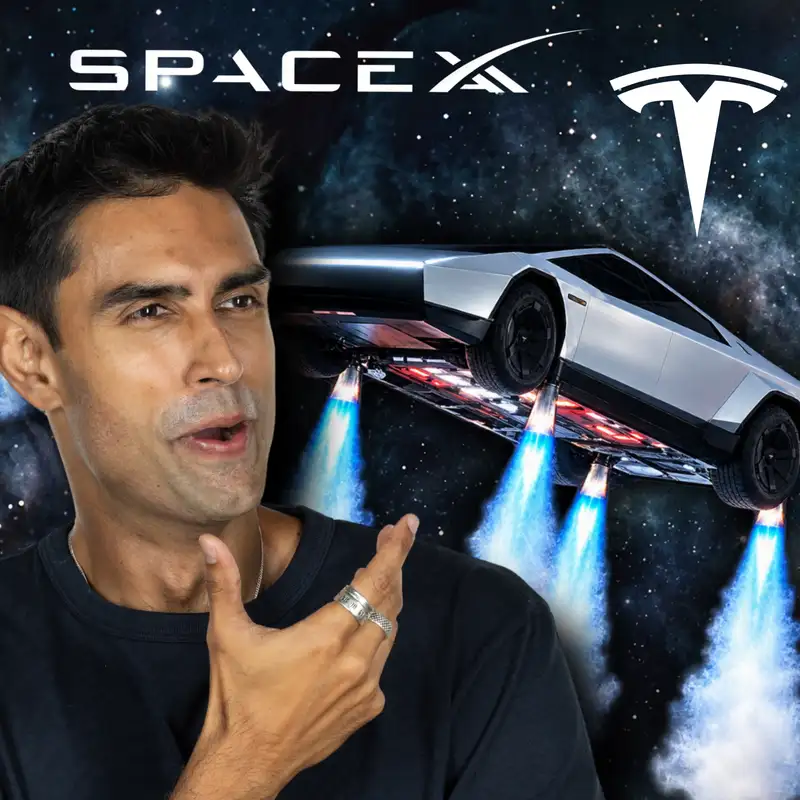
Tesla's Flying Roadster Is Really About SpaceX
It's been almost a decade since Tesla debuted the Roadster, their flagship car,
and last week on Thursday, Elon Musk finally showed us the car.
I watched a Tesla Roadster car drive up a ramp, turn upside down while stationary,
staying stuck to the ramp, launch itself off said ramp,
fly through the air, and then land perfectly into cruise control without a single
dent or bit of damage on the car.
Now, I understand what I just described to you sounds like AI,
but it is anything but AI.
And it uses some really neat physics tricks that I'm going to get into.
But I realized it is the perfect combination of SpaceX and Tesla engineering
that is going to propel, pun intended, cars, manufacturing and automobiles into the future.
We are actually getting flying cars. But it also told me another story and the rumor mill is going.
That Tesla and SpaceX might actually merge by the end of the year,
forming what is going to be the fifth largest company in the entire world.
I'm still in Japan. It's my final day. I've got my kimono on,
but I'm excited to get into it and back to the regular schedule starting on
tomorrow's episode. So all of this and more on today's episode of In The Loop
brought to you by Qualcomm.
Okay, so first we have to watch this video. There's jets of air propelling itself out of the car.
It's spinning the car onto its front. It's landing it perfectly.
There's a loud whirring noise when you listen to this video of air suction.
You're wondering what on earth is going on.
And then you're thinking, is this video sped up or slowed down?
How on earth is a car able to stay stuck to the wall?
Well, there's actually three neat physics tricks happening here,
which combines SpaceX's engineering with that of Tesla's, which has produced
a new type of car which can only be classified as a flying car and this wasn't
the only neat trick that they showed us at the pre-launch event for the roadster i watched this car
fly over trucks and cars i watched it go from 0 to 60 mile per hour in 0.81
seconds which is the fastest of any road car ever and it basically got me questioning
everything that i know about cars and what they're about to become
so i wanted to understand the first trick which is
how on earth did they get a car to stick to the wall because what you're seeing on your screen.
Is in real time. And so no way could a normal car stay stuck to the wall,
it would have fallen and crashed to the ground.
Well, this car is equipped with an immense fan suction system.
So it's embedded on the underbelly of the car, and it is sucking out all the
air from underneath the car.
And what this does is it creates an immense downwards force or downwards pressure,
pushing the car onto any surface that it is driving on.
Now the power of this force is up to 4,700 kgs, which is around 4.7 tons.
That is a lot of force, 2 g's worth of force.
And so therefore when the car is upside down or perpendicular to the ground,
it's still enough to stick it to whatever surface that it's riding on, in this case, the ramp.
And so that's what effectively is happening underneath the car that causes it to maintain traction.
Now you might be wondering what is the physical or practical reality of this?
Well, you can imagine if the car is moving at high speeds and you don't want
it to barrel roll, or if you want it to have the best traction or safety when
you are turning the steering wheel, this gives you that added traction.
Now, the second trick that you saw were these jet streams that were shooting
out of the car at weird times to try and stabilize its direction and help it
land beautifully after it propelled itself off of the ramp.
What I'm showing you on your screen now is something that Tesla's calling their thruster.
But this thruster isn't like any
typical thruster that you would see on a rocket or that of any other car.
It contains highly pressurized compressed gas in this spherical shape that you're
seeing on your screen right now.
And this gas is basically released and it expands super aggressively or very
quickly in milliseconds, such that it creates this immense force that can push
the car in multiple different directions.
Now, the car itself is fitted out to the max with these thrusters.
They have about 10 of them.
And coincidentally, these are the same thrusters that SpaceX used on the Falcon 9.
So the spherical storage tank that you're seeing right at the end of this thruster
basically is the container for
this highly compressed gas. It's usually a mixture of nitrogen and oxygen.
The cool thing about this is there's zero fuel or petroleum involved anywhere. It is just gas.
And then you have an electric valve, which basically opens at a given point
or time due to various different sensors and allows the gas to release and expand.
And then Newton's law of motion applies here, where if it pushes a car in a
certain direction or forces enough gas in one particular direction it can push
the car stabilize the car in a particular different way
and so as you're going back to the original demo that i showed you when it propels
or launches itself off of the ramp
these gas streams from these different thrusters help stabilize it now the scene
i immediately think of when i watched this was that scene when matthew mcconaughey in interstellar.
Docks the ship and he uses his robot tars to control this pretty precarious
situation using these highly pressurized jet streams of gas to make sure or ensure.
That the spaceship lands in a very specific way.
That's exactly what this Tesla car does. And it's worth pointing out that SpaceX's
supply chain is probably the only one belonging to any space company or any
company in the world that could do this at scale.
Now, Elon Musk did go on to say that the release of this car is probably going to be sometime in 2028.
But the point is, if you are any other space company that wants to try and recreate
this, there's no way that you could get it down to a cost optimal path.
I'll get into prices later. But the idea here is,
this is a first of a kind. But the third and final trick is something that is a lot more relatable.
It is wings on the back of the car that you're seeing on the screen here fold
out from the trunk like area of the car.
And it does so in a very sleek and subtle way. Now, if you're a fan of Fast
and Furious or any racing movie, you typically see this kind of architecture
on the back of a car that goes super fast because there's less drag.
It's way more aerodynamic.
And it creates, most importantly a downward pressure as the car is moving fast.
Now think about it if you have a car that's moving incredibly fast but doesn't
have any downward pressure as soon as you steer the car it goes out of control
and it starts to barrel roll but if you are able to generate downwards force
then we have a different situation.
Now this version or this form of the car is known as track mode and I believe
it's towards a model that doesn't have the expensive fan suction system that
you're seeing in the earlier demos that I showed you.
But it's still cool nonetheless, and it achieves downwards force.
Bigger than any other car or road car or land car that is accessible to an average user.
And it's almost to the level and point of an F1 car. And you're achieving something
similar at a regular consumer car.
Pretty insane. And honestly, I have to give it to Elon and SpaceX and Tesla
in general, because they managed to keep this a secret for so long.
And on this video here, you'll see the footage that they released afterwards
of all the test runs that they did to try and create the thrusters that would
be repurposed from SpaceX rockets to make sense
for a regular consumer car to show the jet streams propelling the car up and
making sure it lands in a safe-like manner.
I'm guessing they went through so many different types of crashes.
The formation of the fan suction system to make sure that it generates enough
downward pressure so that you can literally drive your car upside down and to
create the wing system as well to do this for an average regular car that doesn't
have the fan suction system. Now, in terms of price.
They didn't really release any at all. But they did say that if you want the
performance version, it's a $50,000 deposit.
If you want the thrust version, which was the Jetstreams that you saw on your
screen, it's a $250,000 deposit, a quarter of a million dollars.
And then you have the rocket version, which is, as far as I'm concerned,
undefined, which is invite only.
So it's been, what, almost a decade since they announced the Roadster,
and it's gonna be another two years until we actually get access to this thing.
So it's still TBD whether this actually gets mass produced, but it's such a
cool car demo. But stepping away from the sci-fi of it all, there is a more
strategic reason why I think Elon Musk is creating this car.
He's demonstrating that he can merge some of the most powerful capabilities
and technologies from both companies to create something net new that the world has not seen.
Now, it's no secret that Elon Musk has been incredibly bullish on space.
He's been bullish for various different reasons. He believes getting humans
to extraterrestrial planets is one of the most important things.
Kardashev's law of scaling to kind of harness the energy of the Sun,
in this case, to power AI models and generate compute, an abundance of compute
that he thinks will help power the world and generate tons and tons of wealth
for anyone and everyone in the future.
But also to create as many robots, and robots come in the form of cars or humanoid
robots in Tesla Optimus.
As we can so that you can help humanity propel as AI and robotics merge.
So then it would only make sense if Tesla and SpaceX would merge.
Now, if you watched one of our early episodes almost a year,
maybe a year and a half ago, you knew that we predicted it on this show.
We predicted well before SpaceX actually IPO'd that SpaceX should end up merging
with Tesla because there's so much synergies between the two.
Tesla has all these different battery packs that would be required to power
the data centers that SpaceX and its AI efforts were trying to push out.
And simultaneously, SpaceX could benefit from all the humanoid robots that they
were building to help autonomously build spaceships, to refuel rockets,
and help achieve Elon's cadence of launching a rocket every hour,
whatever that is, by 2032.
And the rumor mill says that we may get an announcement as early as December
or first week of December from Tesla announcing that they have plans to merge.
Now, Elon has been a little vague about this, but he has been suggestive,
and it wouldn't surprise me if this deal ends up happening.
Now, the rumor also says that the most likely structure is SpaceX acquires Tesla
in an all-stock deal, where Tesla shareholders get about 0.7%.
SpaceX shares per Tesla share, plus a likely premium.
And so Barclays says that Musk would own about 37% of the combined company with
roughly 56% voting power.
Now, the combined valuation of both of these companies would put it at the fifth
largest company in the world. And listen, I have thoughts about all of this.
I get the camp of critics that say that Elon is just doing all these different
fancy demos to raise as much money as he can so that he can kind of keep the wheel going.
And there's a lot of validity behind it, because although these concepts are
very cool to watch and talk about and show because it's pretty viral, blah, blah, blah.
The question about whether they can actually scale this to a mass audience is
still uncertain, and it's still probabilistically a harder feat to actually pull off.
We have to figure out the manufacturing of all of these things.
We have to figure out getting the cost down so people can actually afford and buy it.
You need to figure out the safety laws behind this. There has never been a flying car.
There needs to be a lot of regulation and laws formed around these different kinds of things.
And of course, Elon is very infamous for having delayed production times and
the Roadster is actually the most delayed product that has come from one of Elon's companies.
But on the other side, Elon is the only entrepreneur and innovator that is doing
stuff like this. He's the guy that had the wacky wild idea of launching GPUs into space.
And now it looks like it is very likely over the next couple of years.
He was the first one to say that electric cars will become way more popular than petrol or gas cars.
And back then, I remember, everyone thought he was crazy and he was able to pull it off.
Everyone thought he was crazy when he said launching rockets and reusing them.
So catching them and reusing them was impossible and he's been able to demonstrate it. Now of course.
Demonstrating it and mass scale, as I said earlier, is a very different thing.
But consolidating all these companies is going to help him achieve his goal
versus keeping them as separate entities. So I'm glad to see that some of this
consolidation might be happening.
And it's a huge win for SpaceX, especially after their IPO and for Tesla,
whose stock has been fairly flat over the last year.
Now, speaking of IPOs, Anthropic is set to have a blockbuster IPO at $2.2 trillion valuation.
And they're set to have their IPO roadshow start in about two weeks' time.
And the idea here is they'll release their S1 prospectus, which will basically
reveal all the details of their finances over the last year and a half to two years,
and also their pitch as to why you should invest in their IPO,
except the tide seemed to have turned recently on Anthropic.
I'm showing this tweet by Andrew Curran here, where he basically goes,
there was a meeting that happened between Anthropic and investors where they revealed some numbers.
And the headline number is Anthropic's third quarter revenue rose 45% to $16.8 billion.
Now, to put that into context, that is humongous. In the first quarter of this
year, they earned about $4.3 billion, and the second quarter was $11.5 billion.
So between the first and the second quarter, it jumped up over 100%.
And then in this third quarter, it jumped up another 45%, except investors are
reading that as things are slowing down, which is, I guess, accurate,
but still a crazy take because that is a heck ton of money.
And they are on track to hit in Q4, an ARR of about $116 billion.
Now, that is a far cry from what Dario initially predicted at the start of the
year of $10 billion. So Anthropik is easily one of the fastest growing companies in the world.
And yet the market is still reading it as bearish. That Anthropica promised to keep.
Growing their revenue, and they're currently showing a slowdown.
And people are attributing the reasoning to losing enterprise market share to
their competitor, OpenAI, who have launched, in their defense,
a really good coding model that has improved drastically over the last six months.
Codex, people have been shifting over to it.
I think this is a bit of a nothing burger. I'm showing this tweet from John
Dunnigan on my screen, where he basically talks about Anthropic agreeing to
license this technology from a company called Opaque Systems.
Now, Opaque Systems basically helps you or your models train on proprietary
data, like from an enterprise, in a completely encrypted and secretive manner,
which should give enterprises the confidence that they can use cloud models
without knowing that they're going to steal from them.
So I think this is a nothing burger. I think that Anthropics revenue is still
soaring. And I think the fact that their revenue is down due to adjusted basis
performance or whatever that might be, is because they have to spend so much
money to acquire compute.
If you've noticed, the cards or the tables have sort of changed between OpenAI
and Anthropic. Typically, OpenAI is the one that has most of the compute and
Anthropic has to hold back on releasing their models or rolling out to anyone
and everyone specifically.
But that has flipped over the last couple of weeks when OpenAI has suddenly
become constrained and raising the prices of their subscription whilst halving
usage capacity. And Anthropic has actually had more abundance of compute rolling
out to as many users as they can.
So I think that after Anthropic announced, I believe a few weeks ago,
that they wanted to or they plan to spend over half a trillion dollars over
the next 10 years on compute, that this is probably where the money is going
to. But there's also another reason.
I think that these AI labs, not just Anthropic, are very close to achieving
something called recursive self-intelligence, where basically
you have an AI model that can build and design the next version of itself,
which means that this whole acceleration of AI models, the improvement of them,
the power of them will be reached much, much quicker.
As these models work 24-7 overnight.
And Dwakesh on an interview this week actually confirmed, or he said,
at least from himself, his own claim that Anthropic employees have been talking
to him saying that RSI will be achieved as close as within the next nine months.
OpenAI has said something pretty similar, but it's not without evidence.
Anthropic's code changes that they've been pushing autonomously via their models,
via their agents. And by the way, I think it's 50% of all code is currently
being pushed autonomously or generated autonomously by their models.
And almost 90% of all code generated has had AI models involved.
So we're not too far off AI models just taking over the whole process,
but where the gap is, where the delta is, is taste. These AI models...
Whilst they're good at executing, aren't really good at figuring out what tasks
they should do or what the design of the research is that they should go after.
And Anthropic researchers are
basically saying, we're going to get there within the next nine months.
And if you look at the data, changes merged per day on Anthropic's monorepo,
it has absolutely shut up.
It has 10x'd since May. As this tweet says, Claude is able to autonomously iterate
on research loops, micro-optimize complex programs, and build new services from
the ground up at a speed and scale we haven't seen before.
Now, speaking of Frontier Labs, one which is relatively new to the scene,
Meta, has been doing some pretty awesome stuff in the open source world.
So let's get into that on today's episode brought to you by Qualcomm.
Mark Zuckerberg started his whole AI effort at Meta, pushing open source forward.
It started with the Llama series of models and ended with Llama 4,
which was at the time a huge disappointment.
Since then, Meta has basically fired their entire AI team, spent upwards of
$50 billion to acquire around 150 to 200 people and form Meta Super Intelligence
Labs. And they've pushed out a bunch of AI products, which I've absolutely hated.
But recently, a bunch that I absolutely love. And part of this is their series
of models called MuseSpark. You've got 1.1, 1.2, and 1.3.
And 1.3 is a really good model. It's a coding model and an agentic reasoning model.
It's not necessarily frontier, but it works really well for specific niche use
cases or specific work that you might want to kind of point and shoot an AI agent or AI model at.
And this week, Mark Zuckerberg decided to open source that model.
Now, think about this. This is a model that they have spent billions of dollars
pre-training, post-training, proprietary designing, and then now releasing to
the wide world to actually use.
Now, there was a lot of critics, including myself, that basically thought that
once Meta had fired and hired a new AI team, once they had failed on their initial
open source LLAMA series, that they would not open source models.
So it's pretty awesome to see that the American frontier of open source is so
back and it's led by none other than Meta.
But the coolest part about this story is that this new model,
MuseSpark Open, can actually run on the latest Mac Studio, and they launched
it in partnership with Apple.
John Turnus, who is the new CEO and actually a hardware guru at Apple,
he's been there for 18 years building some of the most popular devices that
you and I use in our daily lives, and.
Was the man that kind of helped engineer or make sure that the design of the
Mac Studio was something that could befit a model as large and as big as Muse Spark Open.
Now the stats for this thing is pretty cool. Alexander Wang basically says that
this is an 816 billion parameter model, which is fairly big.
And let me tell you, the American frontier for open source was way,
way, way behind. So seeing something like this become available to anyone and
everyone in the West is pretty awesome to see.
Also, it's just good to see competition in general. And when you look at the
benchmarks, it is great at GDPVAL, which is essentially general common knowledge work.
So if you want to give it access to a tool to help you do your work,
it's really good at that.
But it's also good at agentic reasoning and long horizon tasks,
which basically means if you give it a task that is meant to typically take
days, it can actually keep working on it and have between a 40 to 50% chance
of actually getting it right.
And I expect to see that stat increase in.
Many times over as these models start to improve, which begs the question, how soon will that be?
Well, technically, Meta has released seven new models over the last three months.
So that's a new model every, I think it's 11 or 13 days, which is absolutely insane.
Because just a year ago, we wouldn't get a new model until we waited for three months.
And that was from the Frontier Lab. So for Meta to be so far behind and catch
up to where they are today is really awesome.
And I'm glad to see open source winning. And then the final item on the docket
is Google generally releasing their new Gemini 4 model, Argon.
Now, I spoke about this last week when I had a conversation around whether Google
can actually pull off a comeback.
They had the lead or they were near having the lead at the end of last year,
which was not that long ago.
But since then, they underwent a lot of problems at the company.
The DNA of the company decided to spend resources pretty haphazardly.
They decided to build models that weren't really engineered around what customers
or the market actually desired. They didn't focus on enterprise.
They didn't really focus on consumer.
They built many different models that worked in different subscription packages.
It was a whole palaver and mess, which ended up in Demis Sissibis stepping away
from the company or stepping away from his AI role at the company.
And also a lot of key staff like Noam Shazir leaving to OpenAI and others leaving to Anthropic.
So Google was in a bit of a precarious situation. But they have since released,
finally, after delaying their model, Gemini Argon 4. And the reviews.
I have to say, are actually quite good.
My main concern for this model was that it was benchmarked. Because when I looked
at the benchmarks last week, it looked pretty damn impressive.
But I had to question how on earth they were able to pull this off.
Like, what did it actually feel like to use this product? Now.
I'll be the first to put my hands up.
I don't know yet. I'm going to spend the weekend actually using the product.
And if it's good or if it's bad, I'm going to give you a review next week.
So stay tuned for that episode. But from the feedback that has been given from
people, Ethan Mollick goes, I spent a decent amount of time with Gemini 4 before
launch. Overall, Gemini 4 is a big jump over previous Gemini models.
And it is the first non open air anthropic model to pass the fable Mythos Astrobar.
So he's basically saying this thing is pretty damn good.
It is also much more pleasant and more agentic than previous Gemini models.
Basically, the taste of the model, it's much more easier to deal with.
In fact, a big advantage is that it has a very different personality and sense
of taste than Claude or Astra, which is a big deal.
So when I'm using Claude, it is very verbose.
It says way too many words, and I have to read an essay every time I have to get an answer from it.
Now, with Astra, I don't have to read an essay, but it is quite sycophantic
when I don't want it to be. It's quite agreeable when I don't want it to be.
I want it to push back more. Ethan basically says that Gemini is not like that.
But he also says that it's still not the best model to use when it comes to
coding, when it comes to the majority of his work.
But it's good to sort of bring into the fold and kind of get it to acclimatize
to whatever work you're doing.
And maybe in some cases, it actually benefits or excels. Justine Moore from
A16Z said that it has really good visual intelligence.
And what you're seeing on your screen here is she asked it to create an interactive
museum for Apple computers. And it is pretty damn impressive to see. Am I making sense?
It's just a crazy world. But Gemini is really pushing the frontier forwards.
And, you know, we'll see once I get my hands on it, whether we can do something cool here.
And that is it for the roundup. I will be back in the hot seat next week,
maybe drop the kimono and wear something a little more normal.
But thank you so much for listening. I love interacting with you guys.
I love reading all your comments, whether it's good, bad.
Criticism is always welcome. I'm always trying to figure out different ways
of improving. So, you know, send me a DM, just even say hello or suggestions
on any other topics that you have.
And yeah, I guess that is it. I will see you on the next one.
Thank you for listening to today's episode of In The Loop brought to you by Qualcomm.
Creators and Guests