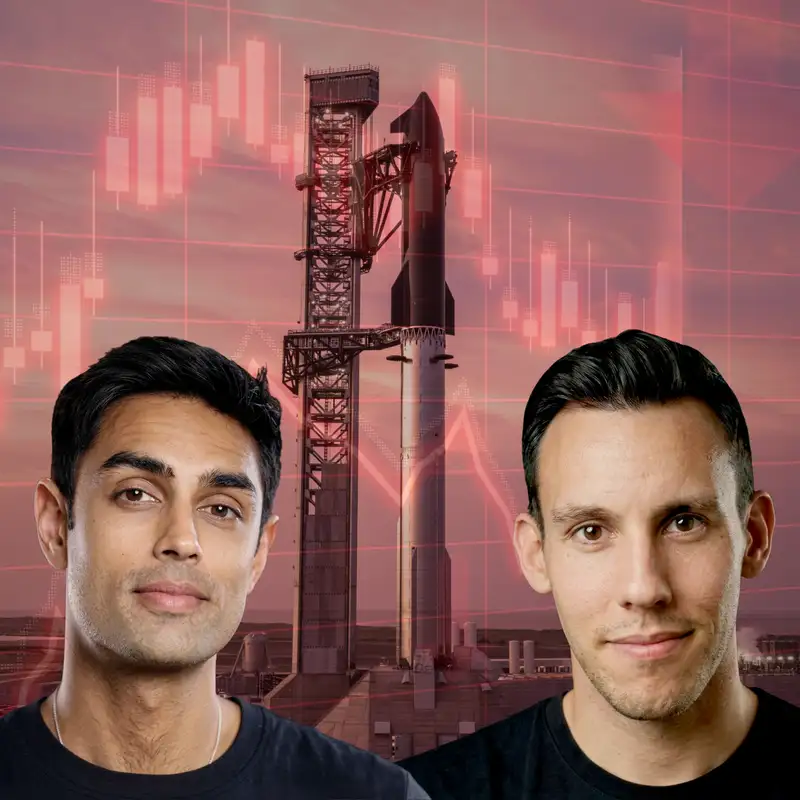
SpaceX Stock Crashed. Starship Flight 13 Didn't.
Ejaaz:
Since they IPO'd six weeks ago, SpaceX stock has absolutely crated.
Ejaaz:
It's down more than 50% from its all-time high. And as we're recording this,
Ejaaz:
it reached a new all-time low of $107 per share.
Ejaaz:
So the question on everyone's mind is, is SpaceX done for? Was it massively
Ejaaz:
overpriced? Will this company make it? Well, this might be a hot take,
Ejaaz:
but I think that the market is incredibly wrong about SpaceX.
Ejaaz:
And I think it's an incredibly mispriced asset.
Ejaaz:
Think about it from two simple perspectives. In order to get the best AI model
Ejaaz:
out there, you need the most energy. Where do you get the most energy?
Ejaaz:
From the sun. In order to do that, you need access to space,
Ejaaz:
cheap access to space. SpaceX is the only company that has the advantage here.
Ejaaz:
And they recently had Flight 13 for their new spaceship, which was a massive
Ejaaz:
success. And they launched Starlink V3. It was an incredible test.
Ejaaz:
We're gonna get into that.
Ejaaz:
The bull case and the bear case is gonna be a sobering take on Limitless,
Ejaaz:
which is, you know, unique for us on why SpaceX is a generational company.
Josh:
The bull case is mostly determinant of just the baddest technology that they
Josh:
are producing now. And I think we're going to talk about that a lot in terms
Josh:
of actual market sentiment.
Josh:
It's tough, right? It's like the stock IPO and it was incredible.
Josh:
It went up to $225 per share.
Josh:
That's over two and a quarter trillion dollar market cap, which,
Josh:
you know, that's unreasonable. That is so much money. The multiples on the returns
Josh:
in terms of how much revenue they're making are just astronomical. It doesn't make sense.
Josh:
It's not just the public market that can't figure out how to price this.
Josh:
There's a lot of values from these privately held banks that are trying to put
Josh:
price per share estimates on it.
Josh:
And they still can't figure it out either. I think this is the widest distribution
Josh:
of what banks are kind of valuing the company at. We have Morningstar putting it at $63.
Josh:
And then we have Morgan Stanley on their bull case putting it at $600.
Josh:
And to me, that signals that this company is mostly misunderstood.
Josh:
People don't know how to value it. They don't know how to value a company that
Josh:
is planning to change the world today.
Josh:
Because a lot of the value is promised in the future. So how do you trade that?
Josh:
What multiple does that trade at? And maybe in order to better understand that,
Josh:
we could talk about the real technology that they're building that's going to
Josh:
get them to this spectacular market cap. Because I can be empathetic.
Josh:
I mean, if you bought this a couple weeks ago at 225, it's been a tough ride.
Josh:
I think we're here to provide a little bit of reassurance that like,
Josh:
hey, short-term, unsure, but long-term, there's some really compelling cases
Josh:
to be made for why Starship, for why SpaceX in general, there's going to be
Josh:
a lot of star naming in this episode.
Josh:
Is a really spectacular company. And it has monopolies across the board and
Josh:
things that other companies just can't really compete on.
Ejaaz:
I think it's important to lay out the bear case for SpaceX, because we've been
Ejaaz:
incredibly bullish about Elon Musk and all of his companies on this show.
Ejaaz:
And in fact, I think both of us bought the IPO when it did an IPO.
Ejaaz:
So we're in it with everyone. If you're an investor that bought that IPO, we're here with you.
Ejaaz:
We feel your pain. So let's walk through the bear case. Well,
Ejaaz:
I'm definitely also unbothered, but we'll get to the bull case a little later.
Ejaaz:
But let's let's look at the bad case let's see what the armchair critics are
Ejaaz:
saying online the i told you so's okay so there's a few things happening right now number one
Ejaaz:
the fact that SpaceX was probably massively overvalued. We know that Elon Musk,
Ejaaz:
in order to execute on his vision of turning civilization into a Kardashev type
Ejaaz:
one civilization, you need a lot of money to do that.
Ejaaz:
Space travel is incredibly expensive. So he tried to raise as much money as he can.
Ejaaz:
That's what he eventually did. The market is now showing us that it wants to
Ejaaz:
kind of reprice it to what it's actually valued at.
Ejaaz:
And so it IPO'd at $135. It's now sitting at an all-time low at $107.
Ejaaz:
I think as we're looking at our screens right now, it's at like $111 at the time of recording.
Ejaaz:
Another big critic is only 4% of the share supply was revealed or made available
Ejaaz:
for everyone. That is out of, I think it's around 16 billion shares.
Ejaaz:
And I think another 1 billion worth of shares gets unlocked in about a week's
Ejaaz:
time, August 6th, I believe, which is two days after their first quarterly report.
Ejaaz:
So there's a lot of things going on here. People are speculating,
Ejaaz:
is the Q3 report going to be very good, or is it going to be bad?
Ejaaz:
Well, if you look at their financial statements from 2025, it's kind of sobering.
Ejaaz:
They took a net loss of, I think, $4.5 billion.
Ejaaz:
The Grok models, as we know, hasn't been able to keep up with the frontier until
Ejaaz:
recently with Grok 4.5. We have a lot of information on that going forward as part of our bull case.
Ejaaz:
But the point is, there is a very low float.
Ejaaz:
And if the stock price isn't able to keep up and maintain its high price on
Ejaaz:
a small float, how do we expect it to do it on a large float?
Ejaaz:
For the rest of the year, I think something crazy like 56% of the rest of the
Ejaaz:
stock supply is aiming to be unlocked and you need purchases to be able to support that.
Ejaaz:
So we understand the bear take, but there is also a lot of good things that
Ejaaz:
are expected for this company.
Ejaaz:
And as we said on our ball case episode around the SpaceX IPO,
Ejaaz:
this is a long-term investment.
Ejaaz:
If you believe that space travel, harnessing the sun's energy,
Ejaaz:
Training AI models on infinite energy is incredibly important.
Ejaaz:
If you believe that robotics, if you believe that Tesla and SpaceX are going
Ejaaz:
to have a merger eventually or that they're synonymous companies run by the same CEO,
Ejaaz:
then you believe that SpaceX is going to be a fundamental and once in a generation
Ejaaz:
type company 10 years out from now.
Josh:
In summary, I mean, SpaceX is trading at about 80 times sales,
Josh:
which is incredibly high. I mean, Palantir is the next highest.
Josh:
Everyone freaks out about that, trading at about 60 times. This is a huge multiple on the future.
Josh:
Here's the future that they're building. And this is where I want to talk about
Josh:
the kind of technical features of SpaceX as a company.
Josh:
And there's four key pillars that we could talk about here. One being Starship.
Josh:
The second being Starlink, the satellite network above our heads currently flying right now.
Josh:
The third is the AI opportunity. And the fourth is their ability to manufacture
Josh:
physical things better than everyone else. So maybe we should start with Starship
Josh:
because Starship launch flight 13 just happened last week and it was glorious.
Josh:
Starship, for those who are not aware, this is the Mars rocket.
Josh:
This is the moon rocket. Now, it's mostly known as the lunar rocket because
Josh:
the plan is to get a Martian base, get a mass driver, a lot of sci-fi stuff.
Josh:
But to bring it back down to what just happened, basically, 407 foot skyscraper went into space.
Josh:
This was their 16th attempt and it actually worked about as well as it could have been.
Josh:
So there's a few things that they're testing for each one of these launches.
Josh:
The first is the ability to actually get the rocket into space,
Josh:
which clearly it did very well.
Josh:
The second is to land both of the objects back on Earth.
Josh:
Those went well. We'll talk about that in a second. And the third is the ability
Josh:
to actually distribute payload into orbit.
Josh:
And for the first time ever, that went well with real production hardware.
Josh:
So we've seen these Starship launches before. We've got the Starship into space and it's distributed.
Josh:
They use this thing called the Pez dispenser, which is a funny way of just kind
Josh:
of distributing these Starlink satellites.
Josh:
One thing noteworthy about this is for the first time ever, Starship launched
Josh:
active Starlink version 3 satellites into space. These weren't dummy units.
Josh:
They were actual real pieces of hardware that are now connected to the Starlink
Josh:
network and have all of the capabilities available.
Josh:
Of direct to sell and much more bandwidth than we're used to traditionally with
Josh:
the Starlink terminals.
Josh:
The other thing that it did really well and that we're watching on this launch
Josh:
video right here is that it actually landed back on the ocean softly for the
Josh:
first time. You'll notice that it landed so soft that the rocket actually didn't explode.
Josh:
It was incredible and it's been floating there. I think it was floating there
Josh:
for like over two days, almost three days, just floating around in the ocean
Josh:
because it landed so softly it didn't blow up.
Josh:
And then there is the booster, which we've seen them land before a few times on those arms.
Josh:
It didn't do that this time, that wasn't in the test, but it had a pretty decent
Josh:
landing to the point where they'll be able to test that again.
Josh:
So this launch went about as good as it could have been.
Josh:
You'll notice the heat shields on this video that we're seeing, that did well.
Josh:
A big part about re-entry when you're rapidly deploying these rockets is making
Josh:
sure that you can rapidly deploy these rockets.
Josh:
And a big part of that is protecting your rocket ship from the re-entry burn.
Josh:
The ship is going like at many times the speed of sound through a very dense
Josh:
atmosphere, and it causes a lot of heat.
Josh:
You'll notice that from flight 10 all the way on the left to flight 13 all the
Josh:
way on the right, that heat shield is doing really well. So all the signs are
Josh:
pointing towards rapid reusability coming up quickly, so much so that the next
Josh:
Starship launch flight, they're going to test the landing of the actual ship.
Josh:
So we're going to get a video, probably, of the ship actually landing back on those chopstick arms.
Josh:
And I think that's going to be spectacular. So everything so far is working fairly well.
Ejaaz:
My major takeaway from this is the technology is so far advanced at SpaceX for
Ejaaz:
spaceship flight, at least, versus any other company.
Ejaaz:
I think their nearest competitor is Jeff Bezos' Blue Origin,
Ejaaz:
that Elon is just in a field of his own right now. But I think what a lot of
Ejaaz:
the market and investors are thinking right now is, I don't see how this materially
Ejaaz:
impacts my life today. So why should I care about this?
Ejaaz:
How do I price in what these rockets are eventually going to bring to me?
Ejaaz:
I don't have that kind of an effect on myself right now in my day-to-day life.
Ejaaz:
And I think that's probably a fair take, but it's also, in that very same sense, a mispriced take.
Ejaaz:
I mean, look at this thing. This thing is like larger, we're launching things
Ejaaz:
that are larger than the Statue of Liberty, for reference here, right?
Ejaaz:
And then we're putting like thrusters on these things, 33 Raptors,
Ejaaz:
and we're just sending these things with massive payloads.
Ejaaz:
I think it's like 5,000 tons into space to release these Starlink satellites.
Ejaaz:
I think it released 20 V3 Starlink satellites, which is more broadband connectivity
Ejaaz:
than Starlink has had in its previous generation. So it's just insane how much
Ejaaz:
Power and innovation is in these actual things.
Ejaaz:
That being said, it's an expensive endeavor and there is a high error rate.
Ejaaz:
But if there's one man to pull it off, it's Elon. And he's repeatedly shown
Ejaaz:
this with his other companies at Tesla.
Ejaaz:
And he's done this at SpaceX for over 20 years now. So is the market mispricing
Ejaaz:
this asset? Yes, potentially.
Ejaaz:
But also, this is over a long time horizon type of thing.
Ejaaz:
If you're investing in this and you're looking at this for over,
Ejaaz:
say, a six-week period, this is probably not the right kind of asset to invest
Ejaaz:
in. This is a long-time thing, and this is something that I personally have
Ejaaz:
a lot of conviction on. But one thing to mention about this company is
Ejaaz:
it's not just about SpaceX anymore. It's not just about space in any kind of material sense.
Ejaaz:
It is about AI and a number of different other things.
Ejaaz:
So as we know, SpaceX and XAI merged about, I think a couple of months ago,
Ejaaz:
Pre-IPO, and they are currently in ownership of all the Grok models.
Ejaaz:
And Grok actually came out with a new model, 4.5 recently. And while Grok 4.5
Ejaaz:
isn't necessarily a frontier model, it is about 80 to 90% of a frontier model,
Ejaaz:
and it's incredibly cheap, and it's very fast to use.
Ejaaz:
And in this current world, where a lot of enterprises are spending tens to hundreds
Ejaaz:
of millions of dollars on AI every single year, they're looking at ways to cut
Ejaaz:
down costs. And Grok 4.5 is a really good way to do that.
Ejaaz:
But the second major thing is Elon has built one of the largest compute clusters
Ejaaz:
for GPUs, better than anyone and everyone. He's aggressively expanding it.
Ejaaz:
He announced, I think, Colossus 4 a few weeks ago. Now, the reason why this
Ejaaz:
is important is Thank you.
Ejaaz:
The scaling laws haven't changed. More compute equals better AI models.
Ejaaz:
So if you are Mark Zuckerberg or if you are Elon Musk, who have the largest
Ejaaz:
data centers right now, you have a good shot of taking on the likes of Anthropic
Ejaaz:
and OpenAir at some point.
Ejaaz:
And this is shown in the model release cater. So we have Grok 4.5 right now,
Ejaaz:
but in two weeks' time, as of this recording, you're going to have Grok 4.7.
Ejaaz:
And then two weeks after that, you're going to have Grok 5. And each of these
Ejaaz:
models are successfully much larger than its predecessor, which means it's more
Ejaaz:
intelligent and more effective and arguably could catch up to the very capable
Ejaaz:
Fable and Mythos models that come from Anthropic
Ejaaz:
And GPT 5.6 that comes from OpenAI right now. So that's another major business unit.
Ejaaz:
Then the final thing is the fact that when you have all this compute,
Ejaaz:
what's the best thing to do with it if you're not training your own models?
Ejaaz:
It's selling it to other businesses. And SpaceX has indirectly become one of
Ejaaz:
the largest neoclouds out there to the tune of, I think it's like they're selling
Ejaaz:
$60 billion worth of compute over the next, I think, nine to 12 months.
Ejaaz:
Anthropic is one of their largest purchases, paying them $1.25 billion per month.
Ejaaz:
So the point is, whilst it might be losing money right now, while space travel
Ejaaz:
might be a very expensive business, it has all these other business units which
Ejaaz:
are looking to be incredibly profitable in the near future. And I don't think
Ejaaz:
people are pricing that in.
Josh:
Yeah, the iterative nature of SpaceX is, I think, something that only people
Josh:
who observe it on a regular basis witness.
Josh:
And from the people who aren't there on the outside it just looks like these
Josh:
products don't really change or evolve much but when you see them on a per product basis how
Josh:
quickly they iterate and how strongly they grow it's really amazing when you
Josh:
think about the raptor engines the engines that power starship from version one to version three
Josh:
the efficiency has gone two to three
Josh:
x every single time the cost has gone absolutely ridiculous in terms of
Josh:
the downwards direction this happens with the starlink terminal satellites like
Josh:
you mentioned it has every one of these version 3s is equivalent to 20 times that of a version 2.
Josh:
Same thing happened with their Starlink terminal. They're now on version five.
Josh:
The new version is 60% more efficient.
Josh:
And all of these increases compound in a way that adds a tremendous amount of
Josh:
value to each one of these verticals.
Josh:
In the case of the AI argument, the AI pillar of this company,
Josh:
I mean, you mentioned that no one's really able to build as fast as they are
Josh:
and iterate again, as fast as they do.
Josh:
They built that Colossus data center in what, 160 something days,
Josh:
which is like many many hundreds of days faster than any other company can yeah
Josh:
by a long shot and the next one's going up even faster and the iterative nature
Josh:
of their ability to build hard hardware products
Josh:
is i think one of the most compelling values and it gets kind of into that fourth
Josh:
pillar of manufacturing
Josh:
where a company who's able to move atoms in an organized way efficiently and
Josh:
effectively is so much more valuable than a company that isn't because we've
Josh:
gotten good over the last 20 years at building
Josh:
software really well and when you think about the most valuable companies in
Josh:
the world a lot of it revolves around their ability to create software i mean
Josh:
look at all the ai labs we talk about
Josh:
on a daily basis not a single one of them has released any compelling pieces
Josh:
of hardware it's all just been bits on a screen and it's really difficult to
Josh:
manage supply chains and move these things around and that's why we see companies
Josh:
like anthropic companies like google going to spacex and asking them like
Josh:
hey could you give us some of that compute we don't quite know how to build
Josh:
it as fast as you do but we'd love to use it and spacex is the company that
Josh:
can do that and in fact if spacex was just an ai company.
Josh:
It would be the most remarkable AI company in the world because of its ability
Josh:
to manufacture data centers at scale and to do the things required to do so.
Josh:
Remember the episode we filmed a few weeks ago, or even last week,
Josh:
I think it was, where Elon personally purchased a billion dollars worth of power
Josh:
just so he could plug in a Colossus data center and get that online faster.
Josh:
And their ability to do that at scale is something that's really compelling
Josh:
and highly competitive because they can build anything.
Josh:
And when you think about what comes down the line for these companies.
Josh:
You think about, in the case of Tesla, we have CyberCab and Optimus,
Josh:
and there is certainly a world in which these new companies are going to merge.
Josh:
We see a lot of the crossover happening where now cybercabs are equipped with
Josh:
Starlink terminals and Starship is using the cold rolled stainless steel that is used in Cybertruck.
Josh:
And all of this, this hard physical labor is really going into creating a really
Josh:
compelling company, a really compelling manufacturing story,
Josh:
I think more than anything else, and doing so all mostly domestically.
Josh:
There's been this battle to move things back here to the United States and everything
Josh:
that these companies make is right here on U.S. soil. And it's,
Josh:
they just do an amazing job of doing it.
Ejaaz:
I do think to a certain degree, you have to be sort of crazy or delusional to
Ejaaz:
believe in the vision that SpaceX and any Elon Musk company is pitching out there.
Josh:
It's crazy. It is crazy.
Ejaaz:
It's quite out there. And like, I don't blame you for critics that I see in
Ejaaz:
the comments for a lot of our videos where we talk about SpaceX in particular.
Ejaaz:
They're like, you know, you know, this guy's crazy. Like, he's not gonna be able to pull this off.
Ejaaz:
And, you know, as a normal, sensible person would agree with you.
Ejaaz:
But one thing I will say is, if you do believe that this vision is able to be
Ejaaz:
executed upon, whether it's Elon, but mostly his team that does
Ejaaz:
A lot of the hard work, then you can feasibly put an investment thesis against
Ejaaz:
not just SpaceX, but any Elon company.
Ejaaz:
I think about it like this. If you purchase SpaceX stock, you're basically buying,
Ejaaz:
what is it, a space launch company
Ejaaz:
a telecom company, you are buying a GPU data center, and you're also buying a Frontier AI lab.
Ejaaz:
All of that comes packaged in once. And if all of it has to work,
Ejaaz:
if one thing doesn't work, then kind of like the thesis gets broken.
Ejaaz:
But then there's also this other company called Tesla, which is now like a Frontier
Ejaaz:
robotics company. It's not just a car company, right?
Ejaaz:
And so what do these robots eventually need? They need some form of a brain
Ejaaz:
to guide them, to scale them in a mass production type of way.
Ejaaz:
Well, you have Grok models, which are trained on a ton of experimental physical data.
Ejaaz:
And Elon Musk is working on that separately. So at some point,
Ejaaz:
you see a lot of synonymous kind of cohesion between these two companies.
Ejaaz:
So you have to be delusional. Now, to kind of like ground ourselves a bit,
Ejaaz:
there is a lot of bearish events, if you want to categorize it like that,
Ejaaz:
happening over the next six months until the end of this year.
Ejaaz:
The main one, in my opinion, is the supply unlock.
Ejaaz:
If you have 56% to 60% of the entire supply for shares for SpaceX getting unlocked
Ejaaz:
by the end of the year, the big question in everyone's mind is,
Ejaaz:
is there enough money to even support the current valuation that there is?
Ejaaz:
Or should I just wait and see for all of these shares to become unlocked?
Ejaaz:
Let the price find an actual, you know,
Ejaaz:
Price that the market thinks is valuable, if that makes sense,
Ejaaz:
and then buy later on when that price is hit.
Ejaaz:
Now, we don't do investment advice here. We just kind of talk about what our general thesis will be.
Ejaaz:
But let's look at some other companies that were in a similar position almost
Ejaaz:
a decade ago. If you look at Meta, when they IPO'd, I believe,
Ejaaz:
in 2012, their stock price went below IPO price for about a year.
Ejaaz:
And since then, it's gone on a meteoric rise. The same thing can be said of
Ejaaz:
Uber over a shorter timeline, privately held. So the point is companies aren't always fairly priced.
Ejaaz:
I think Elon Musk raised a ton of money to be able to execute on this gargantuan
Ejaaz:
vision that he has. And the market is now pricing it more fairly.
Ejaaz:
Keep an eye on the supply unlocks. The first one is going to be August 7th,
Ejaaz:
two days after their first ever quarterly earnings.
Ejaaz:
I'm curious in those quarterly earnings whether they actually turned towards
Ejaaz:
profitability in some forms of ways. I'm going to look at the individual business
Ejaaz:
units, perhaps Grok specifically.
Ejaaz:
And yeah, I guess we'll see where we go from there. But right now,
Ejaaz:
I'm a long term believer in this company. I believe there's only one person
Ejaaz:
that's able to execute and pull this off.
Ejaaz:
And I believe Elon is that moonshot bet.
Josh:
Agents, you know what else I'm bullish on? It's this company called Ledger.
Josh:
And thank you to Ledger for sponsoring this part of the episode,
Josh:
where if you are building with AI agents, you're worried about security.
Josh:
And an agent with unchecked access is a pretty brilliant but probabilistic teammate
Josh:
with access to important secrets.
Josh:
So Ledger Agent Stack fixes that with four open source tools.
Josh:
DMK Skills and CLIs for Ledger Wallet, Ledger Enterprise, and Ledger Enterprise
Josh:
Multisig that lets your agent work with crypto while you stay in full control.
Josh:
Tell your agent, you can rebalance my wallet, ETH to 40%, fastest swaps,
Josh:
it does the math, drafts the swaps, and then stops.
Josh:
The transaction lands on your Ledger signer and nothing moves until you approve it.
Josh:
Agents propose, humans approve, Ledger's signer enforces.
Josh:
And the coolest thing for me is this works with Cloud Code, Codex,
Josh:
Cursor, and it's all open source, ready today on developers.ledger.com.
Josh:
You can find a link in the description below. Thank you to Ledger for supporting our show.
Josh:
And I want to finish the bullish case for Starship with the manufacturing story
Josh:
again one more time, just talking about how quick they're actually going to
Josh:
make this reality happen. Because Ejaz, you did kind of humble us a little bit.
Josh:
This is a sci-fi future that seems impossible. This seems like something you
Josh:
would read in a book more so than witness it with your own eyes.
Josh:
I've seen it happen with Tesla before. I haven't driven a car in a couple of years.
Josh:
Like the Model Y is the best-selling car in the world. They've done Mission
Josh:
Impossible before. This is not anything new to them.
Josh:
And I see a very clear case in which they could do it again.
Josh:
When you look at Starship, for example,
Josh:
Do you know how long it takes to build a Starship now?
Ejaaz:
It's two weeks.
Josh:
It's two weeks long to build a Starship. Wow. And they're simultaneously building
Josh:
seven of them at once. Is that for the new one?
Josh:
Starship number 41. Wow. Yes, this is Starship version three.
Ejaaz:
Dude. That's so impressive.
Josh:
Ships 41 through 48 are in simultaneous productions. They're building seven
Josh:
of these at once. They're building one every 14 days currently.
Josh:
And that pipeline is going to be increasing significantly. So for this year
Josh:
in 2026, Gwynne Shotwell, the COO, the godsend of SpaceX, Basically,
Josh:
the effective CEO of SpaceX is saying they're planning to launch one starship every single month.
Josh:
In 2027, they're planning to launch one to 400 starships in the year.
Josh:
So the cadence is going to increase significantly. And the way it works is it's
Josh:
unbelievable. It's like these rolls of steel go in and then a 400 foot rocket
Josh:
just rolls out after a couple of days.
Josh:
And they're going to be doing this over and over.
Josh:
And as they do, the Starlink capabilities are going to multiply 20 fold per launch.
Josh:
And all of these things kind of compound in a way that, again,
Josh:
it's that iterative improvement and it compounding on itself in a way that is
Josh:
so incredibly compelling. And you could see how this is going to happen across
Josh:
the company with data centers.
Josh:
The first one's like 160 something days. The second one's going to take 100.
Josh:
The third one's going to take 50.
Josh:
They're just going to continue to iterate their way down. And before you know
Josh:
it, they have this unbelievable ability to manufacture these very complicated things at scale.
Josh:
So that's kind of what I'm looking for. And when I look at these,
Josh:
it's very difficult to value something on an exponential curve because of how
Josh:
slow that initial exponential is before it kicks up.
Josh:
And then once it does kick up, over the matter of a couple of months,
Josh:
it could change the entire look and feel of a business. And we saw this with
Josh:
Tesla in 2018, where it took a very long time. Tesla, for the people who weren't
Josh:
around, it was the most shorted stock in the market for years.
Josh:
And it had the highest short float of any company in the world.
Josh:
And then over one year, it went up like 10x.
Josh:
And it very aggressively repriced because people realized, hey,
Josh:
they actually are going to manufacture the most popular car in the world and
Josh:
figure out the self-driving thing.
Josh:
We're probably going to see something like that happen with SpaceX.
Josh:
It probably takes a long time because, I mean, like you said,
Josh:
there's a lot of bearish signals that they will have to get through first if
Josh:
you are a short-term trader.
Josh:
If you're someone who's interested in the share price this year or next year.
Josh:
This might be a bumpy ride.
Josh:
I mean, because there is a stat that I read that I was like,
Josh:
oh, that sucks. In the case of IPOs in general, the last 15 largest US IPOs since,
Josh:
drawing down 50% since the IPO and have averaged finishing the year down 33% where they go public.
Josh:
So there is no precedent for strong IPOs really in this case.
Josh:
It has the valuation problem where it's trading at 80 times trailing sales,
Josh:
profit is non-existent, there's a long way for it to go.
Josh:
But if you believe in this future, it is an incredibly compelling version in
Josh:
which this company is worth more than many other of the top companies combined.
Josh:
It just takes a long time and and it's hard and it's going to be a really difficult
Josh:
battle, but it is possible. And if you're a long-term investor,
Josh:
that's kind of the thing to hold on to.
Ejaaz:
It's a big vision, but Elon has proven time and again that he is an amazing
Ejaaz:
zero to one physical infrastructure scale.
Ejaaz:
And that's exactly the opportunity that SpaceX presents, albeit at a very ambitious
Ejaaz:
vision. If you think about it, I think in the optimistic timeline,
Ejaaz:
the SpaceX shuttle business itself could pay for the entire company, right?
Ejaaz:
If you think about its vision of putting AI satellites out there to train models
Ejaaz:
on infinite amounts of energy from the sun, Anthropica will want that.
Ejaaz:
OpenAI will want that. All the competitors will eventually want that.
Ejaaz:
And there's only kind of like one highway to get there in the cheapest,
Ejaaz:
most cost efficient way. And that would be through SpaceX. But again,
Ejaaz:
it's a bet on whether they are able to pull it off.
Ejaaz:
When it comes to the stock price in general, even if you are skeptical on the
Ejaaz:
stock price, if you're a bullish person about this, there is a silver lining
Ejaaz:
where it's like, okay, well, if the supply unlock comes on later this year,
Ejaaz:
maybe there's a better way to get access to this.
Ejaaz:
And maybe you just kind of like wait patiently for them to be able to pull this off.
Ejaaz:
But one thing is for sure, Elon is kind of hell bent on making this a reality.
Ejaaz:
And time will tell whether this is something that is going to pay off.
Ejaaz:
Again, you need a lot of time to figure this stuff out. And AI is probably the
Ejaaz:
most mispriced asset in general, because no one knows what any of this is going to do.
Ejaaz:
The point of the kind of like mispriced valuation that we're seeing right now
Ejaaz:
is there's not enough market to uphold these prices. You've got the anthropic
Ejaaz:
OpenAI IPOs coming on later this year, so we're going to need even more money for that.
Ejaaz:
And I think a big precursor to SpaceX going up in price in general will be,
Ejaaz:
does AI create enough GDP value across the entire globe?
Ejaaz:
And that is a question mark, albeit a small one, because it's impacting so many
Ejaaz:
sectors at the same time.
Ejaaz:
So we'll get more clarity over time. But again, once clarity is achieved,
Ejaaz:
you're kind of like a little bit late to that eventual trade.
Ejaaz:
So I understand the bear case. I understand the bull case, but one thing is
Ejaaz:
going to be for sure, Josh and I are going to be up 24-7, racking our brains
Ejaaz:
around this thing until we figure it out, and we'll be reporting on it live
Ejaaz:
on this show every single week.
Ejaaz:
So I think that brings us to the end of this episode. Thank you so much for
Ejaaz:
listening. This was an incredibly exciting episode to do because,
Ejaaz:
you know, we were kind of going against some of our bull cases that we had of
Ejaaz:
the previous one that we had around SpaceX.
Ejaaz:
But thank you so much for listening. If you're listening to this on YouTube
Ejaaz:
and you aren't subscribed, what's happening?
Ejaaz:
Please leave us a comment subscribe turn on notifications it helps us out massively
Ejaaz:
if you're listening to us on spotify or apple music or any way that you're listening
Ejaaz:
to us please leave us a comment or give us a rating it helps us out hugely um
Ejaaz:
but i think that's it is anything else josh
Josh:
Yeah no it's just it's exciting like stars this company feels very very easy
Josh:
to understand if you if you read sci-fi books and you understand the future
Josh:
and you're like oh man this is this is the only company in the world that kind of makes makes me feel,
Josh:
a certain way when I go out and watch these launches.
Josh:
And there's like no one trying to capture and build the future like they are. So it's exciting.
Josh:
And I don't know if it's going to work. It's a really ambitious project.
Josh:
So by betting on the company, you're kind of betting on this really uncertain future.
Josh:
But hey, it's a lot more exciting if it does work than if it doesn't.
Josh:
And I think that's what I'm most excited about. So yeah, like you said,
Josh:
thank you all so much for watching. Don't forget to share it with a friend who might also enjoy.
Josh:
And yeah, we'll see you guys in the next episode.
Creators and Guests