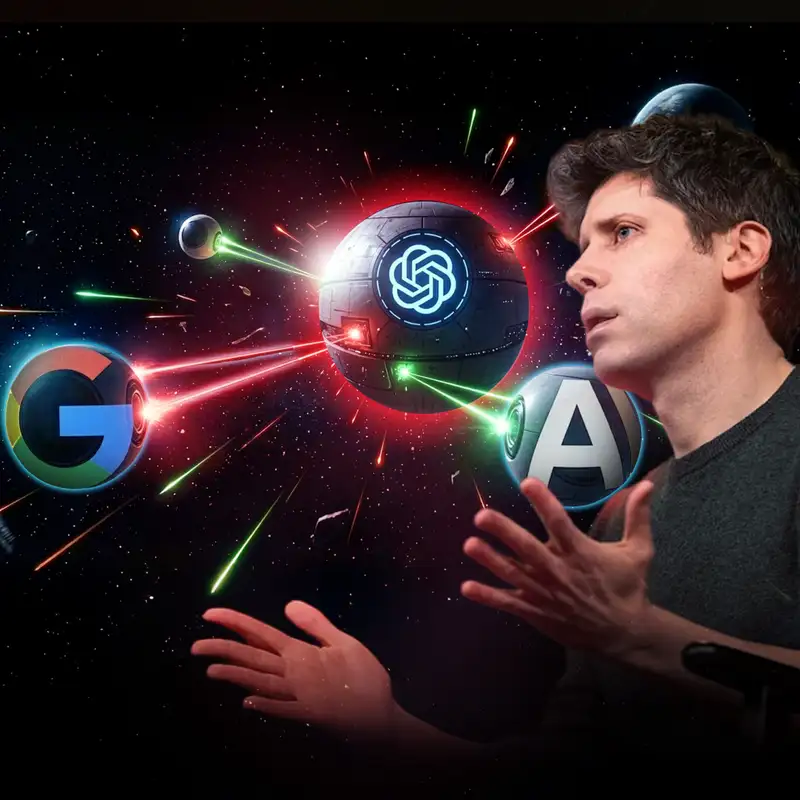
Sam Altman Issues a "Code Red." The Tides Are Shifting In AI.
Josh:
The golden child of AI, OpenAI, has issued a code red.
Josh:
Just this Monday, Sam Altman, he sent out an internal memo declaring code red around ChatGPT.
Josh:
What is code red? We're gonna get into it, but we understand that it's a direct
Josh:
response to the increase in competition from people like Google and Anthropic
Josh:
who are now releasing models that are superior to anything that ChatGPT has ever created.
Josh:
Code red seems a little risky, a little dangerous for a company that is so levered
Josh:
up on future costs and not able to make a lot of money so
Josh:
i'm not really sure what's going on here ejaz you've lived through a code red
Josh:
in the past through previous experiences can you walk us through what it looks
Josh:
like when a company issues a code red because from what i understand the entire
Josh:
company just gets put on pause and everyone focuses on a single
Josh:
existential risk to the company and i assume that's around chat gpt right
Ejaaz:
Yeah, Code Red can be described with one word, Josh, danger.
Ejaaz:
So I experienced a Code Red when I worked at Coinbase, and it doesn't come about
Ejaaz:
too often. And it basically means one simple thing.
Ejaaz:
The core product or the thing that makes your company special and all the money
Ejaaz:
that it makes is in danger.
Ejaaz:
It is about to die and it is under the threat of major competitors.
Ejaaz:
And you need to pile any and every resource that you can into protecting it
Ejaaz:
and making it the number one leader again.
Ejaaz:
And so my experience at Coinbase, when a code red was issued was literally I
Ejaaz:
woke up one morning, Josh, there was a slack message across the entire company
Ejaaz:
saying code red, here's a list of things that we need to do.
Ejaaz:
And I lost half my team to a completely different part of the organization to
Ejaaz:
focus on something else.
Ejaaz:
And that pursued for like the next like quarter or so, which is just kind of crazy.
Ejaaz:
And so in the context of Sam Altman, and with OpenAI, I just want to give a
Ejaaz:
bit of a context as to like how this has come to be.
Ejaaz:
Last week, I'm showing you this article here.
Ejaaz:
It was leaked in an internal memo by Sam Altman that he gathered the company around and said, hey,
Ejaaz:
in the aftermath of Google releasing their new Gemini 3 Pro model,
Ejaaz:
which absolutely blasted them across every single benchmark by a wide, wide margin,
Ejaaz:
we're probably going to face some economic headwinds because what he was basically
Ejaaz:
saying is our models aren't good enough and we have to put in some more effort to catching up.
Ejaaz:
And that kind of, that economic headwinds kind of like transgressed into a hurricane
Ejaaz:
of sorts, if we wanted to keep the analogy going along,
Ejaaz:
into a code red where he's issued an internal memo to his company that we need
Ejaaz:
to gather all resources to make ChatGPT better.
Ejaaz:
And there's three main buckets that they're compiling these resources into,
Ejaaz:
Josh, which I just want to briefly go over. Number one,
Ejaaz:
improve model performance. So that means improving the benchmarks to match and
Ejaaz:
beat Gemini 3 Pro and other competitor models, and also to help on the pre-training
Ejaaz:
and post-training front. So that's where the majority of the resources are going.
Ejaaz:
The second bucket is going to be in image generation.
Ejaaz:
Now, I found this really interesting because this is a direct response to Gemini
Ejaaz:
3's Nano Banana release. We've spoken about this on a previous episode.
Ejaaz:
You should definitely go check that out. I think it was from two weeks ago.
Ejaaz:
But this is their text-to-image editing model, which is actually really good
Ejaaz:
and driving the most usage for Gemini 3 right now. Their downloads are off the
Ejaaz:
charts right now because of this feature.
Ejaaz:
Sam wants to combat that directly. And the third bucket is personalization, Josh.
Ejaaz:
So you and I have said this before, but OpenAI or ChatGPT's moat is personalization.
Ejaaz:
It's memory. It's the reason why you and I consistently use ChatGPT,
Ejaaz:
despite there being a lot of these other models. they understand and they get us.
Ejaaz:
He wants to double down on that. So you might then ask, well,
Ejaaz:
what comes at a cost to all of this? Like what's the price that he's paying?
Ejaaz:
Well, all the efforts and resources that he's been putting into advertising,
Ejaaz:
into consumer products, in agents, into healthcare, all the stuff that he spoke
Ejaaz:
about on his recent developer conference that everyone got super excited about is now void.
Ejaaz:
Sora 2, it's kind of like it's chilling. It's all been put on hold to focus
Ejaaz:
on these three core buckets. He has gone into war mode, Josh.
Josh:
Yeah, it's, um, I could understand why. I mean, OpenAI, they're reportedly valued
Josh:
at what, half a trillion dollars, 500 billion.
Josh:
They have greater than 800 million weekly active users, which has surprisingly
Josh:
and suspiciously stayed the same over the last two months. Every time they mention
Josh:
it, it's been pegged at 800 million per week. So I'm a little curious if that
Josh:
means that they've kind of stalled out on growth.
Josh:
They are still unprofitable, and they have greater than $1 trillion in cloud
Josh:
and chip obligations to companies and partners like Microsoft,
Josh:
Oracle, and NVIDIA. So they have this huge...
Josh:
Like conundrum on their hands where they need to start making money.
Josh:
And in order to do so, they need to have products that are superior to everybody else's.
Josh:
And we have on screen here a few charts that I found fascinating that may have
Josh:
spurred the code red, which is the relationship between Gemini downloads and ChatGPT downloads.
Josh:
EJ, as we mentioned just on our episode earlier this week, how like Gemini is
Josh:
now on the home screen of my phone.
Josh:
And this is a new phenomenon because of how good it is. We talk about Nano Banana
Josh:
all the time. We had an episode just about it because it was so good.
Josh:
And what you're seeing here in the charts is that Gemini is starting to catch up.
Josh:
And I suspect that it's okay if Gemini is a slightly superior model to ChatGPT's flagship model.
Josh:
But if the consumer application, if that product is at threat,
Josh:
which is the ChatGPT mobile app, the ChatGPT desktop app, if that's under threat
Josh:
by a Gemini, then that's a serious problem.
Josh:
And that's what we're seeing reflected in these charts is Gemini as a better
Josh:
model, sure, but it's also now starting to impede on the actual user base of ChatGPT.
Josh:
And when your company is contingent on this exponential line of growth and you
Josh:
have a real threat to that growth, you must do everything in your power to fix that.
Josh:
And that is what the Code Red is all about. It's like, okay,
Josh:
how do we make this product better so we stop losing market share to these other competitors?
Ejaaz:
Yeah, and it's not like this threat isn't very, very real.
Ejaaz:
I mean, look at this chart, right? You've got not only Gemini users and downloads
Ejaaz:
creeping up to match ChatGPT users, they're spending more time on the app,
Ejaaz:
Josh, which has always been ChatGPT's moat.
Ejaaz:
So, you know, we might be fear-mongering a bit here, but it is a very real threat.
Ejaaz:
We've heard feedback from other people, such as this tweet that I have pulled
Ejaaz:
up here, where, you know, this is just a fad.
Ejaaz:
People are only using Gemini because of Nano Banana Josh. Josh,
Ejaaz:
that's the main reason why you have it on your home screen right now.
Ejaaz:
So there is an argument that this might die down in a few weeks.
Ejaaz:
Time will tell, but it's obviously enough to kind of like push Sam into this
Ejaaz:
hole where he needs to kind of like combat this, right?
Ejaaz:
So then the next natural question I would ask is, well, what's he doing about
Ejaaz:
this and how fast is he going to move?
Ejaaz:
There's two main updates that you need to know about.
Ejaaz:
Next week, he's rumored to release a new reasoning model, which is meant to
Ejaaz:
match and even surpass Gemini 3.
Ejaaz:
It's kind of crazy how he's just done that turnaround. We went from like no
Ejaaz:
ChatGPT model for the rest of the year to, yeah, we're going to roll out one
Ejaaz:
next week. So we already see the effects of this code red coming into place.
Ejaaz:
But then, Josh, there is another secret model.
Ejaaz:
Which is planned to be released early next year in January, called Codenamed
Ejaaz:
Garlic, which is meant to be kind of like a GPT 5.5, which represents or implies
Ejaaz:
a major jump in performance,
Ejaaz:
and for them to retake the kind of number one spot convincingly.
Ejaaz:
This is all hearsay right now. I have no confidence that this is going to happen,
Ejaaz:
but these are the kind of like rumors being spread. And Google isn't the only
Ejaaz:
threat that they're facing that is kind of instigating them with this code red.
Ejaaz:
Anthropic has come out of the woodworks with a flashy new coding model,
Ejaaz:
Claude Opus 4.5, which not only maintained their lead as the number one.
Ejaaz:
Coding AI model, but kind of like boosted them even further than they already
Ejaaz:
were. Like they've got like a marginal lead right now.
Ejaaz:
I'm showing up the quick stats on Opus 4.5 right here.
Ejaaz:
You've got stuff as 80% on agentic coding, terminal coding, 60%, agent tool use, 90%.
Ejaaz:
If you compare these to any of their previous models, as well as Gemini 3 Pro,
Ejaaz:
they're absolutely smashing it, right?
Ejaaz:
And so the fact is, despite Google's kind of like advantage with TPUs or whatever
Ejaaz:
stuff, we've spoken about this on a dedicated episode actually earlier this
Ejaaz:
week or last week, definitely go check that out.
Ejaaz:
They've been able to find a secret source to kind of like boosting their models,
Ejaaz:
Josh. And this is one of many good things about this new model release and about Anthropic this week.
Ejaaz:
Josh, do you have any thoughts on this model? The reason why I'm impressed by
Ejaaz:
this is I think coding is such an important kind of characteristic to have or
Ejaaz:
advantage to have for a model.
Ejaaz:
Why? Because if you have the best coding model, you can practically create whatever
Ejaaz:
the hell you want. If there's a competitor that creates a cool new feature,
Ejaaz:
well, hey, Anthropic can just spin up an exact replica and hearsay. Do you feel the same?
Josh:
Yeah. So here's the getting back to the ChatGPT point. Gemini is better at math and science.
Josh:
Anthropic is better at code. That leaves a narrower and narrower sliver for
Josh:
ChatGPT to actually be great at.
Josh:
And this Anthropic model, it's amazing. I think one of the most important things
Josh:
that I want to highlight here is the scores are great but the cost
Josh:
per token is the most impressive because not only is it a huge intelligence jump
Josh:
it is significantly cheaper per token yeah you could see this chart here how
Josh:
much cheaper it is relative to previous models and how we're kind of getting
Josh:
this this exponential increase where it seemed to previously be flattening flattening
Josh:
out we're getting a new increase and
Josh:
anthropic kind of exists in this strange
Josh:
bubble of code but my god is it really good at code and it comes equipped with
Josh:
this new agentic feature where it will actually ask you a series of questions
Josh:
after you submit a prompt that will kind of go through all of the edge cases that you might want
Josh:
and then it will one-shot things that are really impressive we have an example
Josh:
of a designing a front end right
Josh:
yeah this is crazy yeah i mean please look at this
Ejaaz:
Yeah i mean literally like look okay like i don't need to demonstrate the entire
Ejaaz:
video but just look at the prompt on the left here that i'm circling with my
Ejaaz:
cursor and then just look at the result.
Ejaaz:
This happens, by the way, over a matter of like a few minutes,
Ejaaz:
you have like a fancy fintech background,
Ejaaz:
fintech front end, which is what the prompt asked it to build,
Ejaaz:
in a matter of minutes. This would normally take like a Fortune 500 company
Ejaaz:
a couple months to produce about two years ago. And now it's happening in under
Ejaaz:
four minutes, which is just insane to see.
Ejaaz:
But Josh, there's also this really cool blog post I saw about the Red Team project.
Ejaaz:
Can you tell me about this?
Josh:
I love that. This week we have OpenAI with CodeRed and Anthropic with Red Team.
Josh:
And it kind of shows you it's a testament to where both companies are at right
Josh:
now one is very clearly on the defense one seems to be on the offense so part
Josh:
of this new anthropic rollout is they published this blog post
Josh:
about whether ais can actually exploit blockchains and smart contracts so for
Josh:
the crypto fans this is for you um in simulated testing they found that
Josh:
It could gain access to 4.6 million dollars in exploits and again i mean anthropic
Josh:
is the best coding model in the world if you ever wanted to penetration test
Josh:
any software, this would be the model to do it with.
Josh:
And with every new incremental increase and improvement in this model,
Josh:
it unlocks new exploits that we can actually find. So Nick Carter has this amazing
Josh:
take that I love. I'm just going to read it word for word because it's exactly how I was feeling.
Josh:
And he says, within a year, when people tell their AI agent to go make money,
Josh:
the AI will interpret that as go and steal crypto by phishing our exploits.
Josh:
We're going to have to take OPSEC and smart contract security a lot more seriously
Josh:
on a go forward basis and that's that's true it's like you get into the alignment question where
Josh:
like is this ai good or is this ai trying to answer
Josh:
you solve your request and if your request is go make me some money
Josh:
well it'll just go hack from someone else's because a lot of these systems are
Josh:
not secured against the most cutting edge ai just yet so it unlocks this new
Josh:
interesting paradigm that
Josh:
i find is unique uniquely for anthropic in the case because they are just the best at coding
Josh:
and code is what secures all of our financial assets today so interesting thought experiment
Ejaaz:
Yeah. And the fact of the matter is like, you know, this, the coding frontier
Ejaaz:
model is an incredibly valuable thing to have.
Ejaaz:
And the numbers don't lie, Josh. So if you remember, in January of this year,
Ejaaz:
Dario Amode, the CEO and founder, projected that they would probably reach around $1 billion worth of AR.
Ejaaz:
That's currently what that was what the revenue they were earning at the time.
Ejaaz:
He went on stage yesterday and announced convincingly that they are on track
Ejaaz:
for $10 billion of annual recurring revenue at the end of this year.
Ejaaz:
That is a 10x. That is insane.
Ejaaz:
And so it's going really well. He's on track to hit that $70 billion projected goal,
Ejaaz:
ARR in 2028, which we spoke about a few episodes ago, which will make them the
Ejaaz:
first profitable major AI lab in 2028, beating OpenAI, who's projected to get there in 2031, 2032.
Ejaaz:
So all things are in favor of Anthropic to kind of like do something pretty
Ejaaz:
dramatic, such as a IPO, maybe.
Ejaaz:
Rumors broke, maybe, well, maybe convincingly from an insider.
Ejaaz:
News broke that Anthropic has engaged a firm to start prepping them for an IPO
Ejaaz:
in 2026. Of course, there hasn't been any official confirmations yet,
Ejaaz:
but the regulations and the docs do not lie. um.
Ejaaz:
It also says that Dario is in the kind of midst of closing a massive round,
Ejaaz:
which would value Anthropic at $300 to $350 billion, which will place them up
Ejaaz:
there with OpenAI, who's currently valued at $500 billion.
Ejaaz:
And with OpenAI going into Code Red, with Anthropic entering Red Team and this
Ejaaz:
new Frontier model, maybe they might be even worth the same amount, if not more.
Ejaaz:
So that's just a very interesting kind of like run for Anthropic in general.
Ejaaz:
I saw this tweet, I want to mention it very quickly, that states that Anthropic,
Ejaaz:
might even value the IPO at 300 to 350, which would mean that they don't make
Ejaaz:
any money on it. And the argument for that would be they've already raised so
Ejaaz:
much money that they don't need it.
Ejaaz:
And it is more beneficial for investors to purchase or buy Anthropic stock in the future.
Ejaaz:
I don't know this is all hearsay, but it's something interesting to kind of check out.
Ejaaz:
And the final thing I want to make a point of is these IPO valuations,
Ejaaz:
Josh, are getting absolutely insane.
Ejaaz:
I have this really fun anecdote where a Chinese AI company, which is meant to
Ejaaz:
try to compete with NVIDIA, IPO'd on the Chinese Stock Exchange this week.
Ejaaz:
And Josh, it IPO'd for 4,000 times oversubscribed, which placed it at a 4.5 billion.
Ejaaz:
A trillion dollar market cap beating nvidia's market cap now that was for a
Ejaaz:
brief moment it is now regulated down but it just shows the insatiable appetite
Ejaaz:
and demand for ai stuff right now.
Josh:
Yeah the the four and a half trillion dollar number it's outrageous it's not
Josh:
the only company with the valuation close to that high that we're going to talk
Josh:
about this week we have updates from amazon amazon's been moving kind of slow
Josh:
out of all the mag 7 companies they are the
Josh:
the one showing the least amount of growth this year so it's it's fitting that
Josh:
it's their time is coming if not already here ijaz and you have some updates
Josh:
for us about what they actually announced this week at their aws event so can
Josh:
you walk us through where does amazon stand why are they losing and why is that
Josh:
hopefully not indicative of the future growth that they're going to see from this ai
Ejaaz:
Advancements you can see i'm rubbing my hands josh for those of you who are
Ejaaz:
listening i'm rubbing my hands uh the reason why is uh i've been purchasing
Ejaaz:
amazon stock recently um right before.
Josh:
We recorded actually you guys were saying i'm dcaing in right now
Ejaaz:
Oh yeah oh yeah um and it's because i have an amazon thesis which is it is a sleeper ai stock hit um
Ejaaz:
and this uh set of releases the slew of ai releases that aws um launched this week is proof of that
Ejaaz:
um so i'm going to quickly run you through it um they released a new uh ai chip
Ejaaz:
or ai gpu which competes directly with nvidia's gpus and Google's TPUs.
Ejaaz:
And it's cool for a few different reasons. Number one, it's four and a half
Ejaaz:
times more performant than the previous Tranium chip that they launched.
Ejaaz:
This is Tranium 3. I'm talking about Tranium 2.
Ejaaz:
It is 4x more cost efficient. So it's cheaper.
Ejaaz:
And it also has higher memory bandwidth, which makes it just all around like
Ejaaz:
a really good infrastructure product to use for people to train their models.
Ejaaz:
So that's super cool. And I think it kind of competes directly with NVIDIA in
Ejaaz:
the sense that it can get you about 80% as good as NVIDIA GPUs, but 50% cheaper.
Ejaaz:
So for anyone that's kind of like running on NVIDIA GPUs and they're like spending
Ejaaz:
billions of dollars, they could slash that bill by half, which is really cool.
Ejaaz:
The other really cool thing that they released is something called Nova Forge.
Ejaaz:
In a single sentence, it allows any enterprise to train their own AI model using their own company data.
Ejaaz:
The reason why that's cool is, imagine, like ChatGPT is good,
Ejaaz:
right? But imagine if you had ChatGPT for your own company, imagine how productive
Ejaaz:
you'd be. Imagine how productive each of your employees would be.
Ejaaz:
That's a really unique thing. And it just tells me that like Amazon is going
Ejaaz:
down the enterprise route, similar to the company that they have a 19% stake
Ejaaz:
in, Anthropic, right? So I kind of see the alignment here.
Ejaaz:
And the third point is around these three agents that they released,
Ejaaz:
which basically helps them automate a bunch of things using AI.
Ejaaz:
The way I think about it is Amazon's kind of like the automation AI giant.
Ejaaz:
And I think they're going to do really well, Josh.
Josh:
Yeah, Amazon. I mean, we could lay out a bit of a brief bull case here because
Josh:
I'm super excited about Amazon, too.
Josh:
I was looking at the Mag7 leaders, like who in the Mag7 moves the most amount of atoms?
Josh:
Because when you apply this AI leverage to these companies, the ones that move
Josh:
the most amount of atoms stand to benefit the most.
Josh:
And we have Tesla, we have Apple, we have Microsoft, we have Google.
Josh:
But Amazon moves the most amount of physical stuff in the world by a large margin.
Josh:
I think they're estimated, what is it, 6 to 7 billion orders per year,
Josh:
containing 12 to 15 billion items shipped in 8 to 10 billion packages globally.
Josh:
So in the US alone, that's like 6.3 billion partials in 2024.
Josh:
They're on track for 8.4 billion in 2028. It's a huge amount of stuff just moving around.
Josh:
And when you apply automation to that stuff, you can cut your cost and increase
Josh:
your margin at such a significant rate that amazon stands to benefit hugely from this automation
Josh:
and we're seeing this with the things that they announced this week with in
Josh:
terms of like building their own
Josh:
vertically integrated ai systems we have some interesting takes on chips that
Josh:
they're making so to me amazon is just like poised to explode just because the
Josh:
sheer amount of volume that they move throughout the physical world
Ejaaz:
I i that's such a good point josh did you see the news uh that got released
Ejaaz:
this morning about the USPS stuff?
Josh:
No, what was that?
Ejaaz:
Okay, so get this. Amazon currently pays USPS six to $7 billion a year for them
Ejaaz:
to ship packages for them, right?
Ejaaz:
Because they don't want to like, they can't claim everything because like,
Ejaaz:
you know, you can use the existing postal network.
Ejaaz:
They announced plans, they being Amazon, that they're going to create their
Ejaaz:
own postal service equivalent this morning, which will basically wipe out $6 to $7 billion.
Ejaaz:
No other company can do this to the scale that Amazon is doing it. It's just insane.
Ejaaz:
The other thing I wanted to address, because I know you listeners,
Ejaaz:
I've read all your comments. I know exactly the criticism you're about to give
Ejaaz:
to this segment is, oh, but NVIDIA is still good because everyone is using their
Ejaaz:
software CUDA, C-U-D-A.
Ejaaz:
Amazon has a special source in response to that, which is with their new Tranium
Ejaaz:
chip, they have software that you can just simply port from NVIDIA's to Amazon's,
Ejaaz:
which makes the switching cost not just a hardware consideration,
Ejaaz:
but an easy software consideration as well.
Ejaaz:
Now it becomes really easy if you're running a NVIDIA GPU cluster on AWS to
Ejaaz:
hop onto Amazon. So it's actually a really smart strategy. And I'm pretty,
Ejaaz:
I'm bullish, Josh. Can you tell? Yeah, I can.
Josh:
The switching cost being as close to zero as possible is huge,
Josh:
right? Because like as much,
Josh:
I'd say what CUDA is to NVIDIA memory is to OpenAI, where it is a very strong
Josh:
moat. And if you can, it's basically saying we can make your memory portable in a commercial way.
Josh:
And that's a huge unlock for anyone who is interested in using these AWS chips.
Josh:
Now, when they make it, I don't know.
Josh:
There are some problems in the world of computers, particularly around RAM right
Josh:
now. If you have ever built a computer before, you know about RAM.
Josh:
RAM is this, it's the very lightning fast memory that holds temporary memory, but it's very fast.
Josh:
And it's required for training AI data centers, so much so that there has become
Josh:
this egregious shortage of RAM.
Josh:
And for people who haven't lived through the previous GPU cycle,
Josh:
there was this huge problem where you couldn't buy an NVIDIA GPU because they
Josh:
were being used for crypto miners.
Josh:
And if you're a hobbyist at home, now you can't buy RAM for your computer because,
Josh:
well, the prices have tripled in the last 12 months.
Josh:
And this comes on the back of an announcement from a company that makes the crucial RAM.
Josh:
They just stopped making it for commercial purposes. They're using it only for
Josh:
institutional entities, for private entities who are building AI.
Josh:
So now one of the three major manufacturers of this RAM is stepping away.
Josh:
If you are building a computer, I am sorry, it is about to get a lot more expensive.
Josh:
If you are building an AI data center,
Josh:
It's also expensive, but now you at least have one of these three major suppliers
Josh:
explicitly making stuff just for you.
Josh:
So just something to note that there are these supply chain crises happening.
Josh:
This most recent one is in RAM. Previously, it was GPUs. I guess it's still GPUs.
Josh:
But as we go along, it's going to be interesting to see where these kind of bottlenecks form.
Josh:
And just in terms of, you know, bubble watch, we just want to see where everything's landing.
Josh:
This is the RAM segment. Here's where it is. It was getting very high very quickly.
Josh:
One of the companies bowed out. And that's just kind of like the nerdy hobbyist enthusiast,
Ejaaz:
Like state of the union for it. Sorry, Josh. Sorry. I can't let you get off
Ejaaz:
the hook that easy. You sent me this website and it looks intense.
Ejaaz:
What am I looking at?
Josh:
I can't believe you've never used PC Part Picker. If anyone has ever built a custom PC before.
Josh:
There's a lot of compatibility issues between parts because sometimes a specific
Josh:
manufacturer's piece does not work with another manufacturer's piece.
Josh:
So what PC Part Picker does is it allows you to place all of these pieces into
Josh:
one place and it'll tell you which is compatible with which.
Josh:
It also does a great job of tracking prices of these items. And what we're seeing
Josh:
here in these charts that are all going up and to the right is the price for
Josh:
the average person to get their hands on a critical piece of compute hardware, which is the RAM.
Josh:
And there's another nerdy joke she made here where now developers are going
Josh:
to have to actually optimize their websites because a lot of the times these
Josh:
big clunky websites and the big clunky code, it all gets stored in your RAM
Josh:
because they just throw it in there's no budget.
Josh:
Well, maybe if there's a budget, they'll start making more efficient code.
Josh:
But that's kind of a deep cut.
Josh:
I don't want to spend too much more time on here. We have other interesting
Josh:
things to talk about, mostly in the world of Apple.
Josh:
There is a big switch up this week in Apple world. Please, Ejaz, tell us what happened.
Ejaaz:
Well, I want you to tell me about this, Josh. This is your favorite company
Ejaaz:
ever, Apple, and they just lost their chief of AI.
Ejaaz:
John is leaving and he's being replaced by this guy called Amar from Microsoft,
Ejaaz:
and is joining to lead AI under Craig Federini.
Ejaaz:
Can you give me the law of this?
Ejaaz:
Is this kind of bearish,
Ejaaz:
eventually bullish or should I just be bearish?
Josh:
I don't really, I don't know these guys. It's like, I mean, Apple AI sucks.
Josh:
So whoever's in charge of it, like, sure, get rid of them. Whoever tried,
Josh:
they failed clearly because like, I still don't have Siri enabled and they're
Josh:
now hopefully going to outsource to Gemini.
Josh:
I think this is probably a good thing. If you're in charge of AI at Apple,
Josh:
you probably should be fired.
Josh:
I find it funny how everyone kind of reports to Craig Frederici.
Josh:
So everyone comes in and out, but Craig is always that guy. He's always sitting
Josh:
there he never takes the blame he never takes the fall um i'd be curious to know
Josh:
how much of this is his responsibility versus people who are beneath him um
Josh:
but yeah it's funny actually the first comment says under craig federighi that's
Josh:
the problem right there um so
Josh:
I don't know where to stand on this i know that apple's ai sucks i hope this
Josh:
new guy i mean god speed brother amar whatever you're like whatever you're doing
Josh:
i wish you all the best i hope you figure it out um that's kind of what i got for this
Josh:
there is another guy as well i was gonna say this is the more interesting conversation
Josh:
to me at least i think uh which is this guy who was previously in charge of
Josh:
a lot of things at apple his name is alan dye and he's
Josh:
responsible for this whole slew of things he was working on packaging then he
Josh:
helped with the ios 7 redesign he created the dynamic island he led the ui for
Josh:
vision pro he helped with the vision pro launch he did liquid Glass, he did all of
Josh:
the human interface spatial computing things.
Josh:
And he just, one of the things that we love and one of the things that I'm personally
Josh:
excited about in the future is to switch to spatial computing.
Josh:
And this guy did a great job. Like Vision OS looks great. Liquid Glass,
Josh:
we've had our debates on the show. I think it looks pretty good.
Josh:
This is the guy kind of behind and in charge of all of that stuff.
Josh:
And Meta poached him for a presumably ton of money. Meta said,
Josh:
hey, we'll pay you whatever you want. Come over here, do it for our products.
Josh:
That's presumably going to be for the meta ray band displays that we had a few
Josh:
episodes on earlier on and
Josh:
it made me a little bummed because this guy actually did do a great job on these
Josh:
apple products and now he's going to be going to develop for meta who makes
Josh:
really crappy hardware products in really siloed software suites um so
Ejaaz:
To have a little bit of sweet zuck is really on a on a rampage isn't he to just
Ejaaz:
kind of like hire the talent from everywhere but like will he actually prove
Ejaaz:
it like listen he spent what 25 billion dollars in hiring like a hundred people,
Ejaaz:
less 100 people actually at 30 35,
Ejaaz:
to 40 people and like i haven't seen the fruits of that labor so like is he
Ejaaz:
going to do the same thing with design and his glasses probably not it was an
Ejaaz:
absolute shambles of a launch so we'll see uh josh do you know anything about
Ejaaz:
the guy that's replacing this apple design guy steve lemay.
Josh:
New guy uh no other than the fact that he's been around for a very long time
Josh:
and apparently has been here since 1999 he helped ship the original iphone uh
Josh:
mac os ios iPadOS, watchOS, and most recently, visionOS.
Josh:
So somebody who was around during the Steve Jobs, Johnny Ive era seems bullish.
Josh:
That's about all of the context clues that I have. But hey, again, I wish you the best.
Josh:
I hope you could help Apple figure it out. They have a lot of figuring out to do.
Josh:
And that's just, we're going to take it from there. But there is another interesting
Josh:
topic that I want to cover here, some science corner stuff, which is pretty cool.
Josh:
We found sugars in outer space, essential to life.
Josh:
This is kind of cool. It was found on some asteroid that was in deep space.
Josh:
And it is one of the first times that we actually discovered some sort of building
Josh:
blocks for life that came from outside of our galaxy.
Josh:
So I wanted to just briefly mention this because it creates this interesting
Josh:
conversation around the Fermi Paradox.
Josh:
For people who don't know the Fermi Paradox, it's the apparent contradiction between
Josh:
The high probability that intelligent life should exist elsewhere in the universe
Josh:
and the total lack of evidence that it actually does.
Josh:
So from a Fermi paradox perspective, this is great and terrible news.
Josh:
Terrible as the paradox is stronger than ever, but great because whatever filter
Josh:
causes the paradox is more likely to be early in our evolutionary history rather than in the future.
Josh:
You can at least make the case that this life was kind of randomly placed
Josh:
and there is a high probability that it can be placed randomly elsewhere because
Josh:
there are the basic building blocks coming from all these external places. What do you think?
Ejaaz:
Listen, my pastime in a very, very long ago life was a biologist.
Ejaaz:
That's what I kind of like studied at university.
Ejaaz:
And all I could help but think when I learned about all these different amino
Ejaaz:
acids, building blocks, DNA, blah, blah, is like,
Ejaaz:
there is so much chance in this that it is almost certain that there exists
Ejaaz:
another universe where there are other sorts of life forms because all the building
Ejaaz:
blocks are just out there, right? So why should we be the only favored ones?
Ejaaz:
Josh, I pulled up the sugar futures chart and I have to say,
Ejaaz:
I have to say, no one seems to be reacting as violently as I had expected here.
Ejaaz:
Listen, I'm a markets man. I'm invested in this stuff.
Ejaaz:
I want to see how I can make returns on this. And I don't know,
Ejaaz:
maybe there's a delay in this information, Josh.
Ejaaz:
Maybe I should be shorting the sugar stocks as much as I can before they kind of catch on.
Josh:
That's so funny. You're the type of guy where like a meteor will hit earth and
Josh:
it will be made of solid gold.
Ejaaz:
And the first.
Josh:
Thing you will do is hop on your computer and figure out how do I short gold?
Josh:
Forget about my bug out bag. Forget about how do I short gold?
Josh:
We just got hit by tons of it on earth.
Josh:
That is so funny. Well, that's, it's just an interesting thing.
Josh:
It's like, it makes you think it's like, okay, we found a critical building
Josh:
block for life that came from another universe, yada, yada, yada,
Josh:
whatever that science corner.
Josh:
We have something important to celebrate as we wrap up this episode which is
Josh:
our spotify wrapped which just came out and we have some really amazing stats
Josh:
and some really gracious thank yous to hand out to everybody because
Josh:
wow i think uh i share this thought in the fact that we are both blown away
Josh:
by the support that we've had over the past year and these statistics that we're
Josh:
showing on screen are like pretty outrageous you guys right like top one percent across the board
Ejaaz:
Top 1% across every single category. So that is a 2025 instant hit show,
Ejaaz:
2025 most shared show. That's you guys listening to this right now,
Ejaaz:
watching this right now.
Ejaaz:
Thank you for sharing it with all your friends. It turns out you guys are listening.
Ejaaz:
Someone's listening to us, Josh, which is great. I wonder if it's the aliens.
Ejaaz:
Exactly. I also do want to point out that our show has only been going for six months.
Ejaaz:
So we got like half a year delayed on the headstart for this.
Ejaaz:
And we still managed to pull the top 1%.
Ejaaz:
No easy feat, Josh. But the one I'm probably most proud of right now is we are
Ejaaz:
ranked as one of the top technology podcasts in the world, ranking at 21, Josh.
Ejaaz:
I can, I can't, I'm not looking at your face right now because I'm staring at
Ejaaz:
the camera, but I know part of you is seething because you want that top 10 spot. And so do I.
Ejaaz:
So we are going to be gutting for this. But what a crazy start.
Josh:
Seething but grateful. Like man, all the people who are listening here,
Josh:
normally it's the real ones that make it to the end of the episodes.
Josh:
So if you're watching still, chances are you're one of the real ones that made this possible.
Josh:
So thank you from like the bottom of my heart, seriously. Like the support and
Josh:
the sharing with your friends and the liking and the subscribing and the rating.
Josh:
Like it really makes a meaningful difference.
Josh:
And we're seeing that support reflected in the numbers for the first time ever
Josh:
really through the Spotify wrapped. And it is so, so awesome. Like it really, it's...
Josh:
It's one thing to see the numbers on the screen but it's a second to actually
Josh:
see the the impact that it has through all of the comments through everyone
Josh:
sharing through just like the nice messages we receive on a daily basis so seriously
Josh:
like thank you so much for the support
Josh:
i think based on this we can give limitless rookie of the year podcast award
Josh:
because like man i think so that was uh it's a pretty crazy run
Josh:
it's a really crazy one we've published 93
Josh:
episodes this is number 94 that will be coming out in a six-month span and if
Josh:
you've listened from number one or if you listen from number 92 um
Josh:
thank you i hope that you have found value in the show i hope that you will
Josh:
continue to find value in the show
Josh:
the frontier is like expanding faster than ever it has never been more exciting
Josh:
to be right on the bleeding edge of it and that's exactly where the show lies so we're going to keep
Josh:
doing more of this i hope you still continue to find it exciting exhilarating
Josh:
we're going to keep working to get better hopefully you can keep working to
Josh:
share this with every single person you know who could be remotely interested in this
Ejaaz:
And we will just continue.
Josh:
Chugging along. Yeah, so who knows? Maybe by next year's Spotify wrapped,
Josh:
we can trim a two from the front of that 21 and just leave it at number one.
Ejaaz:
Oh, that's good. I like that. And the final thing I'll say is,
Ejaaz:
We don't just do podcasts, Josh. We also do newsletters.
Ejaaz:
And I know you guys are reading a bunch of newsletters, but if you'd read our
Ejaaz:
newsletter about a month ago, you would have bought Google stock and you would
Ejaaz:
have been up about 15 to 30% on the stock right now, which is nuts. So I have a thesis.
Ejaaz:
We have a thesis coming out on Amazon next week.
Ejaaz:
So if you want to read that and be notified about that, subscribe to the newsletter.
Ejaaz:
That is all from my end, Josh.
Josh:
That's it. Yeah, and that's Alpha. A few weeks ago, or even a month ago now,
Josh:
he just posted the Google Bowl thesis. And since then, the stock is up quite a bit.
Josh:
So there are some good alpha in these newsletters. I would highly advise you
Josh:
to subscribe. The link is in the description below.
Josh:
But as always, thank you. Seriously, thank you for a great year.
Josh:
We're going to keep on going. The year's not over. It's still early December.
Josh:
We got a lot more to talk about. So we will be back next week.
Josh:
Have an amazing weekend.
Josh:
And we will see you guys then. Thank you.
Creators and Guests