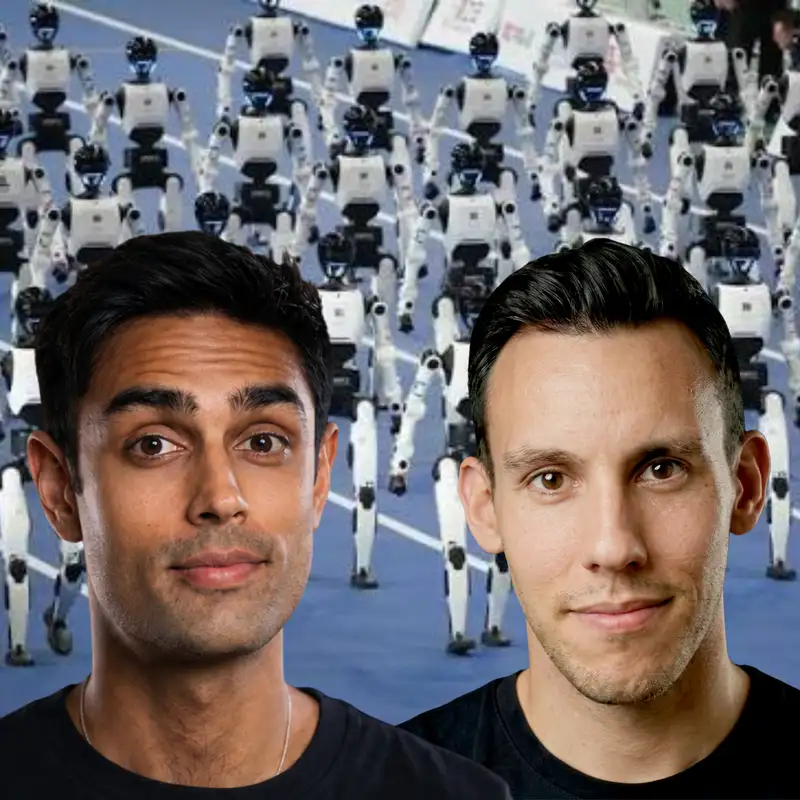
Robot Olympics 2026: China's Robots Just Broke Human World Records
Josh:
26 years ago, a human athlete ran the 1500-meter race in 3 minutes and 26 seconds.
Josh:
And ever since then, the record had never been beaten.
Josh:
We've had seven Olympics, the latest Nike running shoes, and no one has been able to beat it.
Josh:
But over the weekend, a humanoid robot out of China crushed it in 2 minutes
Josh:
and 21 seconds. This was the World Humanoid Olympics that was hosted in China over five days.
Josh:
And these robots are crushing human-based Olympic events.
Josh:
They ran a faster 100 meter than Usain Bolt. They jumped higher than the Olympic record.
Josh:
And they broke 1500 meter and the 400 meter races.
Josh:
We're talking about 2000 robots from over 16 countries that competed in 55 Olympic
Josh:
events. These are the same events that humans compete every four years.
Josh:
And the contrast between last year's Robot Olympics and this year's is vastly
Josh:
different. And we're going to get into all of that on today's episode.
Ejaaz:
This is a visual episode where like, if you're not watching,
Ejaaz:
you're probably going to want to watch these videos because they're insane.
Ejaaz:
This is also a funny episode because one year ago, we actually filmed the first
Ejaaz:
annual Robot Olympics. We are here now for our second annual pretty much any event on the show.
Josh:
Yeah, we're on the zone. To talk about the show.
Ejaaz:
I mean, dude, just look at the visual of the sound screen. This looks like it's
Ejaaz:
AI generated, but it is not AI generated. What we're seeing run across the screen
Ejaaz:
is an army of robots that are perfectly in sync.
Ejaaz:
For this event, the scale is huge. I think the total amount of robots competing
Ejaaz:
is up 300% year over year.
Ejaaz:
And the amount of teams is up like 200% year over year.
Ejaaz:
And the most interesting statistic is 96% of all the robots that competed in
Ejaaz:
this Olympics are all Chinese made.
Ejaaz:
This is the China event. And it's kind of sad because I was looking at humanoid
Ejaaz:
robots from the US and I was like, oh boy, we might just be cooked.
Ejaaz:
So for the records i'm just gonna just list off a couple that are are kind of
Ejaaz:
unbelievable and then we'll get into the videos of how they actually did it
Ejaaz:
the first is the 100 meter gold that is like the flagship race that everyone kind of
Ejaaz:
that denominates in. And that is the one where Usain Bolt famously is the human
Ejaaz:
world record. He ran it in 9.58 seconds.
Ejaaz:
The robot ran it in 9.39 seconds. And oh my God, look at this video. It's terrifying.
Ejaaz:
Could you imagine a robot running at you that fast?
Josh:
No. And also look how tall these things are. I could have sworn that these robots
Josh:
are meant to be like waist height.
Josh:
They were certainly like last year when they were competing.
Josh:
This thing is like six foot three to six foot five. These things are huge.
Josh:
Oh you see the crash pad over here as well where they just kind of like.
Ejaaz:
Slam i find it funny how yeah they crash and they just die like they just turn
Ejaaz:
off and then they have to get dragged off in carts they're coming
Josh:
Because one and done it's nuts.
Ejaaz:
The next one that was kind of crazy is the standing high jump which um
Ejaaz:
was above the human record they cleared 2.8 meter 2.88 meters almost nine meters
Ejaaz:
the 1500 meter race the tiangang ultra is what they call it was two minutes
Ejaaz:
and 21 seconds against a human world record of
Ejaaz:
three minutes and 26 seconds, which was untouched since 1998.
Ejaaz:
And the robot, most interestingly, these aren't human controlled.
Ejaaz:
They ran fully autonomously with zero human intervention.
Ejaaz:
So I think all of these things, as we go through the videos from this event,
Ejaaz:
yeah, here's the robot running 14.5 miles per hour and just running into the barricade.
Ejaaz:
It's the first time that feels scary. And I remember we did this episode a year
Ejaaz:
ago and I was like, okay, robots are kind of a joke. Like they don't actually
Ejaaz:
look like they are doing anything effective. They're not running that fast.
Ejaaz:
They're kind of falling apart and collapsing.
Ejaaz:
Similar things were happening this year, but we're seeing some serious upgrades
Ejaaz:
year over year. And if we continue this trajectory, even one year in the future,
Ejaaz:
that leaves us with a pretty unnerving reality with how capable these robots are gonna be.
Josh:
Yeah, I mean, I remember last year's Olympics. And just so that you guys have
Josh:
an understanding in how advanced these robots have become in a very short period
Josh:
of time, specifically in China.
Josh:
Last year, the 100-meter time, the winning robot ran it in 21.5 seconds.
Josh:
That's like more than double the world record that Usain Bolt held.
Josh:
And now in less than a year, because it has been less than a year,
Josh:
they crushed Usain Bolt's record. So what's that going to be next year when
Josh:
these robots' arms aren't flailing in a crazy way and they're way more dynamically
Josh:
efficient, they're going to crush it even more.
Josh:
And so I think the realization that struck to me is this is,
Josh:
to your point, no longer a joke.
Josh:
The Chinese are very advanced in hardware. We were talking about this before
Josh:
we started recording, but hardware and manufacturing has been their kind of
Josh:
mecca over the last couple of decades at this point.
Josh:
And they have completely beaten the US. When I compare, when I'm looking at
Josh:
the figure robots in the US or any kind of robots, Amazon delivery robots.
Josh:
I'm just like, China is way more advanced. And for humanoids specifically,
Josh:
because this is the other thing, right? It's like, why would these events kind
Josh:
of like matter to us at all?
Josh:
It's because they're human looking robots competing in human based events.
Josh:
Like look, and we're not just talking about, you know, track and field events.
Josh:
We're talking about like football. We're talking about like tennis.
Josh:
Like I think in this one, there's a crazy penalty. Josh, I want to show you
Josh:
this. Hang on one second.
Josh:
So a yellow card on the robot and again if you're not watching this I urge you
Josh:
to and so he lines up for a penno.
Ejaaz:
Drains it absolutely
Josh:
Drains it so the point is these robots are no longer toys and we saw the famous
Josh:
chinese robot lab unitree ipo last week and their stock is up 650 and that wasn't
Josh:
like a pump a dump it's still up around four to five hundred percent
Josh:
so there's obviously a demand for these robots these robots are very much at
Josh:
the research phase until this event which tied in with a very important conference
Josh:
i think it was like the world robotics conference or something like that,
Josh:
where the pitch was essentially, these robots are now physically able to do
Josh:
a lot of complex things that humans are able to do.
Josh:
And you can now apply this to various different industries. And the sports and
Josh:
athletics feed is just one example of that.
Ejaaz:
There's one thing that I want to highlight that I found extremely interesting
Ejaaz:
from this, because one of the new rules that happened this year is that if it's
Ejaaz:
a flat event, meaning like if the robot is on a flat surface,
Ejaaz:
it must be fully autonomous.
Ejaaz:
And this is true for the relay races. This is true for anything on these flat surfaces.
Ejaaz:
And what we noticed this year was a property that a lot of people laughed at,
Ejaaz:
which is this robot, you guys know you saw it, running with its arms,
Ejaaz:
waving, flailing crazy. And this is the best robot. Do we have a video that
Ejaaz:
we can show them? Yes, this.
Ejaaz:
So look at that robot. Look at how they're running with their arms flailing side to side.
Ejaaz:
And I thought this was funny and goofy until I realized that this was actually
Ejaaz:
an emergent property of machine learning.
Ejaaz:
And this was not trained into the robot this was understood and emerged from
Ejaaz:
what yielded the best results and it turns out that like the the robots are
Ejaaz:
getting smart enough where they can kind of
Ejaaz:
Self-recursively loop themselves and come to terms with the idea that this is
Ejaaz:
the optimal strategy and when i look at this i'm laughing because this is kind
Ejaaz:
of what evolution developed as a tail
Ejaaz:
for a lot of animals that were running around like a lot of these large animals
Ejaaz:
that run fast they need a tail as a counterbalance they don't fall over
Ejaaz:
these humanoid robots now are running with their arms flailing back and forth
Ejaaz:
as a mechanism for balancing. And I wonder, I wonder if this is some sort of
Ejaaz:
Move 37 from Go. If you remember, there was like Google's DeepMind computer.
Ejaaz:
It was competing against a human.
Ejaaz:
And on Move 37, it did this like crazy, unbelievable move that no one expected.
Ejaaz:
No one understood why, but it turned out to be genius because it was thinking so far in advance.
Ejaaz:
I wonder what types of emergent properties we'll get and we'll learn about the
Ejaaz:
human body through this.
Ejaaz:
Like perhaps what if Usain Bolt spent his whole life training to run and training
Ejaaz:
to run like this instead of with his arms straight forward like would that turn
Ejaaz:
into a superhuman runner that's even faster I don't know but I find this really fascinating that
Ejaaz:
humans are kind of or the humanoid robots are kind of relearning human movement
Ejaaz:
principles from first principles and the results of that are going to be pretty
Ejaaz:
interesting as we continue to watch these evolve like how are they going to
Ejaaz:
move in a different way than us if if so
Ejaaz:
and this is one of the examples I thought was like super interesting really bizarre and funny
Ejaaz:
but on the inside like very technically interesting It's like,
Ejaaz:
oh, they created their own tail. That's kind of cool.
Josh:
When I look at this, it seems like it's in a perpetual state of falling,
Josh:
like it's about to stumble, but it just gets in front of it just at the right time.
Josh:
Now, the story behind this is actually interesting, just kind of like unpack it a bit more.
Josh:
The makers of this robot in particular that crushed the 400 meter record,
Josh:
a human record, is called Tiang Gong.
Josh:
And the engineers actually had no idea how to teach this robot to run fast.
Josh:
So they started off with the human movement, which is we swing our arms back
Josh:
and forth, right? It propels us forward.
Josh:
And so they built a robot that did exactly that. And they realized that this
Josh:
was incredibly inefficient for their robot.
Josh:
Its rotator cuff, its shoulder started getting really heated and it ended up
Josh:
exploding. So its arms would literally fall off in the test case when they had
Josh:
a robot that would run like a human.
Josh:
So they didn't know, they were scratching their heads. They were like,
Josh:
how on earth do we figure out how to make this robot run super fast autonomously?
Josh:
And so it just gave the robot model that was in its brain the task and said,
Josh:
I will give you more rewards if you figure out how to run faster.
Josh:
Your goal is to get to the finish line as quick as you can.
Josh:
And the robot started doing this. It started swinging its arm from side to side,
Josh:
which basically mimicked the swinging your arms back and forth,
Josh:
forwards as you're running normally like a human, but it had less resistance
Josh:
on the shoulder rotator cuff.
Josh:
So it figured it out on itself independently.
Josh:
And this might be a more uniform way of running. I can't speak on behalf of
Josh:
humans, but certainly for robots, it ran the fastest time it has ever run.
Josh:
I saw another stat that was super interesting. 70% of AI tokens that are used
Josh:
in China are apparently used for video models specifically.
Josh:
And a large chunk of that is for robot models. So when we look at this and we're
Josh:
wondering how on earth is China like, you know, usurp the US?
Josh:
How have they like become so advanced in such a short amount of time?
Josh:
It's because they're spent the majority of their AI tokens and research development
Josh:
on video models specifically.
Josh:
And we see this with like the text of video models that we've seen outside of
Josh:
this that we've talked about on the show on various other episodes
Josh:
they are far superior than the u.s based labs and so this makes sense like when
Josh:
it comes to the world of world models and robotic brains it just has they have
Josh:
a they have us on visual intelligence is what i'm realizing as i'm watching
Josh:
more and more of these videos.
Ejaaz:
One thing that i did want to show i just sent you a post if you don't mind pulling
Ejaaz:
it up yeah because i thought this was so funny too this is what an earlier version of this
Ejaaz:
emergence of understanding human movement looked like this was an early google
Ejaaz:
game mind project and what they did is they gave this like figure human properties
Ejaaz:
but didn't teach it how to walk
Ejaaz:
and you can see it slowly learning over time how to move its joints and its
Ejaaz:
body wow to figure out how to like actually get from point a to point b using
Ejaaz:
a reward system that you just described which is like if you can get to this
Ejaaz:
place you will be rewarded figure out how to get there and you see it really yeah
Ejaaz:
really like weird because it is like a humanoid looking thing and what we're
Ejaaz:
seeing today is not only the evolution of this early technology that we saw at a google deep mind
Ejaaz:
but the iterative improvement so much so that it actually has a physical body
Ejaaz:
to live within when i think about the next evolution of or the next phase of
Ejaaz:
this like general evolution as we get greater intelligence naturally the
Ejaaz:
The hope is to embody that intelligence, to put it into these physical objects
Ejaaz:
that are going to be moving physical atoms around. This is the next thing.
Ejaaz:
It's much more difficult because we have to manufacture things.
Ejaaz:
We're not the best at manufacturing things.
Ejaaz:
But in the case that we are competing head to head with China on manufacturing
Ejaaz:
things and applying AI to it, I see no world in which we stand a chance.
Ejaaz:
And that's a kind of scary place to be because like 96% of these robots that
Ejaaz:
competed are Chinese. And when I look at American robots, they're different.
Ejaaz:
They're different. They're more general purpose. It's much more technically challenging.
Josh:
They suck.
Ejaaz:
They currently do suck. Like, it's funny. I was scrolling my feed.
Ejaaz:
We were talking about this yesterday.
Josh:
Even this robot's head is down. Look at this, Josh. Like at the start, look at it.
Ejaaz:
Oh, he's just so sad. He watched the Robot Olympics. So I'm scrolling my feed.
Ejaaz:
I'm seeing these robots doing like backflips. They're running 20 miles an hour.
Ejaaz:
They're like doing high jumps. They're doing these unbelievable things.
Ejaaz:
And then Brett Adcock from Figure, who is a humanoid robot maker,
Ejaaz:
he's sharing like just robots kind of walking around campus slowly.
Ejaaz:
And he shared a video of like a robot slowly walking up a staircase yeah this
Ejaaz:
one he's like look guys he climbed like 15 feet of stairs and i'm like man i
Ejaaz:
understand these are different robots i understand this is a general purpose
Ejaaz:
robot that can do a lot of things
Ejaaz:
just on a purely optical basis when you look at the videos from the olympics
Ejaaz:
versus when you're looking at the videos from this you're like man we got a long way to go
Ejaaz:
and not only that but we have what two maybe three companies here in the u.s
Ejaaz:
that are doing it we have figure we have tesla
Ejaaz:
maybe there's like boston dynamics china everyone's doing this there is like no
Ejaaz:
specific company that is taking the lead everyone's building these unbelievable
Ejaaz:
robots assuming that this progress continues next year is going to look freaking
Ejaaz:
crazy like i cannot imagine they're probably going to need a bigger arena because
Ejaaz:
i'm sure the robots are going to very quickly outgrow this like small confined
Ejaaz:
space originally meant for humans
Ejaaz:
this was taking place in the olympic stadium that is used for humans uh traditionally
Ejaaz:
i think it's like the 200 meter lap race or whatever it is but really like unbelievable
Ejaaz:
rate of progress and like kind of a scary
Ejaaz:
thing to see knowing that none of those robots belong to us
Josh:
So when i'm looking at this i'm thinking okay we know china is obviously very
Josh:
advanced compared to the u.s but which companies in particular in china are
Josh:
they private? Are they public?
Josh:
Like what's so special about them? What are the name brands that we need to
Josh:
kind of like bring ourselves to be aware of?
Josh:
The winner, the winning brand is this company called Tiang Gong.
Josh:
I don't know if I'm pronouncing that correctly, but Tiang Gong.
Josh:
And it's basically a startup from Beijing, China. And no one kind of like knew
Josh:
about their name very well outside of China, at least.
Josh:
I think the name brand was basically Unitary, which placed second across all
Josh:
the medals that were won so far.
Josh:
Remember, it's still going on as you're listening to this right now,
Josh:
you can probably catch the live stream.
Josh:
But Tiangong, it's a small startup.
Josh:
And they crushed it at the 400 meter, as well as a number of other track events.
Josh:
And the reason why they're getting a lot of the glory right now is,
Josh:
to your earlier point, any kind of flat surface events had to be completely
Josh:
autonomous. So there was no human controller at all.
Josh:
So it's a much harder feat to teach or train an AI robot to basically run around
Josh:
a track or kind of like maneuver around various different obstacle courses.
Josh:
And Tiangong had the best AI model paired with their hardware,
Josh:
right? So it was very kind of like pliable.
Josh:
Now, when you look at Unitree, Unitree is a name brand that I mentioned earlier,
Josh:
that IPO last week, and their stock is up like something like 600%.
Josh:
And I think they're valued at like $55 billion, where they initially IPO'd up
Josh:
like $2 billion. So you're seeing these crazy multiple returns in China as of
Josh:
recent. And it's not just in robotics. It's happening in the semiconductor space
Josh:
with memory stuff. I think they had the CXMT IPO.
Josh:
China's having a bit of a moment with their AI models and with their robotics
Josh:
side of things. and I just want to spend a quick moment kind of describing what
Josh:
those conjectures sort of look like.
Josh:
On the AI model side of things, they have kept up in open source and now they're
Josh:
kind of putting out models that are competing on the frontier.
Josh:
There's this model, I don't know if you've seen it, being tested recently,
Josh:
Josh, but it's called Ox Alpha and many people think that it's meant to be GLM's
Josh:
next model, 5.3, and it's a flash model.
Ejaaz:
Stay tuned for that episode once we know.
Josh:
It's going to be a banging episode, hopefully, once they officially release it.
Josh:
But that is competing at the level of a Fable 5 or a GPT 5.6 Sol.
Josh:
And it's a hell of a lot cheaper. So somehow Chinese have been able to keep
Josh:
up on the software model side.
Josh:
But if you flip over to the hardware side, which it is my strong belief is going
Josh:
to be the next kind of phase or frontier of AI, we're talking about world models,
Josh:
visual intelligence, all that kind of stuff, we see a flow.
Josh:
Where China actually might have the more advanced models and advanced hardware
Josh:
and the scale to pump these robots out. Remember, China has,
Josh:
I think, something ridiculous, like five times more robots.
Josh:
Oh, they produce five times more robots than the US did in all of 2025.
Josh:
And that's scaling on an exponential curve where the US just can't compete.
Josh:
Right now, it's just like two startups.
Josh:
So China's having a bit of a moment and it's something that we need to keep
Josh:
an eye on, both from an investment perspective, but also from like protecting
Josh:
the frontier if the West wants to stay ahead. of, you know, their main adversaries.
Ejaaz:
And it also, it feels like it's private industry versus the government in the
Ejaaz:
US versus China. Like this is interesting.
Ejaaz:
Yeah. The Beijing government, they poured $20 billion in subsidies into the
Ejaaz:
sector over just the last year alone, and reportedly is planning a 1 trillion yuan fund.
Ejaaz:
I'm not sure exactly what that translates to, but that is like a tremendous
Ejaaz:
amount of money that they're putting towards these companies to push the frontier forward.
Ejaaz:
And this is in a way China's advantage
Ejaaz:
where they are able to just force progress by any means necessary.
Ejaaz:
We've seen this many instances with Frontier AI labs where they will just subsidize
Ejaaz:
price or even prior to AI.
Ejaaz:
If there was a competing product from China and a competing product from the
Ejaaz:
United States, what they would do is the Chinese government would step in.
Ejaaz:
They're going to say, hey, we're going to subsidize you.
Ejaaz:
We're going to make the cost lower so that you can outcompete everyone else.
Ejaaz:
The entire market will go to you and then we'll gradually raise the prices up.
Ejaaz:
But they're willing to step in and put their hand on the scale to make meaningful
Ejaaz:
change in the progress of a specific division. And it's very clear that robots
Ejaaz:
is one of their top priorities.
Ejaaz:
And this is interesting. It's happened in the past around manufacturing.
Ejaaz:
I know China has this like requirement for a lot of ships where when they're
Ejaaz:
made, they must be made to a size in which you could fit a tank on top of them.
Ejaaz:
Like you need to be able to roll a tank on top of your boat for it to be classified
Ejaaz:
as a specific type of boat that you could then go off and build and use and
Ejaaz:
get permits for because they they're thinking in this like almost military sense
Ejaaz:
and they have the control over everyone where they can do that.
Ejaaz:
So I think it's really interesting to see the dynamics of kind of like private
Ejaaz:
government versus public industry at play
Ejaaz:
um here in the u.s versus china and so far like capitalism kicking ass but man
Ejaaz:
like china with their subsidies and their
Ejaaz:
their ability to manufacture things at scale it seems like a legitimate concern
Ejaaz:
and sure a lot of this is staged a lot of the software is like pre-coded but
Ejaaz:
the robots are real like those things are
Ejaaz:
real they're produced at scale they're doing the flips they're running the things
Ejaaz:
and they're getting better much faster so if we gauge this on a rate of progress
Ejaaz:
which is all we can ever do
Ejaaz:
uh year over year i'd say they're up like what is this a 10x i remember last
Ejaaz:
year as we were sitting here talking about this it was mostly a joke we were
Ejaaz:
just kind of laughing like hot look at that robot like falling sparks flying everywhere
Ejaaz:
just like dropping dead and totally blanking out but this year it is a very
Ejaaz:
different story and like next year
Ejaaz:
Man, you got to imagine it's just going to be even more slightly deranged than this.
Josh:
I'm not even sure how much of this year's robots were hard-coded.
Josh:
Like when I look at that 400 meter race and that robot kind of developed that
Josh:
weird sideways swinging movement by itself, I think like, wow,
Josh:
okay, so next year's robots are probably going to come up with completely new
Josh:
performant ways that humans
Josh:
probably could learn from at the actual human Olympics.
Josh:
So I'm curious how that develops.
Josh:
But your point around kind of like having a nation state influence and dictate
Josh:
how a certain technology progresses, in this case, robotics,
Josh:
it has had meaningful impact.
Josh:
And listen, like on the West, when I compare it, right, we are arguing to ban
Josh:
data centers almost everywhere in every single state in the US, at least, right?
Josh:
And that is going to hinder progress in massive ways.
Josh:
And listen, some of the reasoning is very valid around electricity concerns.
Josh:
But I know that a lot of the AI labs are taking very meaningful steps to subsidize
Josh:
that and also pay a much larger tax so that it goes to the local community so
Josh:
they can get much more benefits from this kind of stuff.
Josh:
There's a lot of pushback. The general feel and vibe in the Western Front,
Josh:
or I'll speak for the US, is AI is bad. It consumes a lot of water.
Josh:
It is bad for humans. It is taking our jobs. It is replacing us.
Josh:
And I'm not saying that's right or wrong. But when you compare that to China,
Josh:
which is so AI forward, it's just so robotics forward, they are obviously going to get the leap on us.
Josh:
The US government comparatively is like, hmm, should we ban open models?
Josh:
Should we ban some of these other frontier AI models? And China,
Josh:
meanwhile, is like, we're going to do anything and everything to get ahead of
Josh:
this space because we know it's going to be incredibly transformative technology
Josh:
and we'll make it safe when we can.
Josh:
I don't know what the right path is forwards, but we are going to see a stark
Josh:
contrast over the next year is my guess if the two countries don't change their
Josh:
kind of ideological views on how this pans out.
Josh:
What I would like to see, Josh, next year is Tesla Optimus compete in this.
Josh:
I'm sure or I know Elon Musk is looking at this and thinking,
Josh:
hmm, I think I have a card up my sleeve and I can do this.
Josh:
So I'm hoping that the Chinese Olympics, Robot Olympics will be open to taking
Josh:
a Tesla Optimus because I kind of want to see how badass it is compared to it.
Josh:
Now, China, granted, has all the data and information that is required to train frontier robotics.
Josh:
If you look at any of the hardware components, like the actuators,
Josh:
the rotator cuffs, they produce the majority of it.
Josh:
I think actually Tesla Optimus sources a bunch of this from China,
Josh:
But I want to see the Western front kind of like compete on this because right
Josh:
now this feels like the GPT-3 moment Where China had nothing and American had
Josh:
all the frontier AI models, but swapped the other way around.
Ejaaz:
As you're saying that I'm like man, why is it China versus Elon?
Ejaaz:
Why is it not China versus US? Why do we only have Elon and Optimus to put up against him?
Ejaaz:
Maybe the figure robots It is also important to note to play both sides of the
Ejaaz:
coin here that the United States is
Ejaaz:
trying very different strategies than China in the most cases.
Ejaaz:
Like Optimus and the figure robots are general purpose humanoid robots that
Ejaaz:
are met for very different use cases than the ones that we're watching on screen today.
Ejaaz:
The ones on screen today are very narrow purpose. They're built for a singular
Ejaaz:
specific thing, whether it be racing, all these things are within a closed loop
Ejaaz:
system. So we're seeing pickleball so crazy too.
Ejaaz:
How long do you think, or is this tennis? I can't even, it's tennis.
Ejaaz:
How long do you think until a robot can like, EJS, I know you play a paddle
Ejaaz:
all the time like yes what would you give the over under on like say two years
Ejaaz:
before a robot can kick your ass oh
Josh:
Well i mean i would probably give it,
Josh:
two maybe three years because like look at look at how well okay right now this
Josh:
is like the equivalent of me laughing at this right because it looks like there's
Josh:
a young kid playing tennis over here but i said that last year
Josh:
for all the track of it's and now they're beating the world record so if i assume
Josh:
in a year's time this is going to beat like say carlos alcaraz or djokovic then
Josh:
yeah actually maybe even a year it could.
Ejaaz:
Happen could happen it could happen and the thing with these systems is like
Ejaaz:
humanoids that we're trying to build at tesla or figure those need to work for
Ejaaz:
the real world those need to be trained on everything because they need to be prepared for
Ejaaz:
the unknown variables that occur on a day-to-day basis that
Ejaaz:
no computer can really predict what these are doing is they're being trained on very narrow focused
Ejaaz:
versions of that so like this is a ping pong trained robot this ping pong robot
Ejaaz:
cannot go and play tennis it cannot go run the 100 meter dash and win gold it
Ejaaz:
is specific for this one use case and it's very cool to see but it is just a
Ejaaz:
totally different strategy and when i think about
Ejaaz:
where value is going to be derived from humanoids it's certainly across or from
Ejaaz:
just like robots in general it's certainly across the stack but a general purpose
Ejaaz:
humanoid who can do useful productive tasks is going to generally be more productive than a
Ejaaz:
humanoid robot that can like kick like oh my god did you see
Josh:
That do you see that that's great can you rewind that for everyone.
Ejaaz:
For those of you listening this is like a full 360 roundhouse kick and kicked the robot's head off.
Josh:
This is not AI. This is completely real.
Ejaaz:
That's so sick, man. This is basically the- You're like walking out of a bar
Ejaaz:
or something and a robot starts picking a fight with you.
Josh:
And it starts hitting the emotes. The Fortnite emotes.
Ejaaz:
Look at this. It's so insane. I do appreciate that they're having fun with it.
Ejaaz:
But yeah, like that's it. That's what's happening. Like that is the robot Olympics
Ejaaz:
summed up is like, it's scary. Like robots don't suck anymore. Robots are-
Ejaaz:
Clearly the future, they're clearly being produced at scale,
Ejaaz:
and they're clearly finding these emergent properties of human beings that we
Ejaaz:
have not even considered to try yet.
Ejaaz:
And like, this is so cool. If anything, just a really fun visual event.
Ejaaz:
I really enjoyed scrolling this weekend, seeing all the videos from it and just
Ejaaz:
kind of watching in awe at how much progress they've made just in the last 12 months.
Ejaaz:
It's pretty sick. And what's also sick is agents, because if you are not fully
Ejaaz:
operating humanoid robots, chances are you're running agentic robots.
Ejaaz:
And security is a fairly big concern when you're working with agents.
Ejaaz:
And we have a solution for that, which comes in the form of Ledger,
Ejaaz:
our friend and sponsor of the show.
Ejaaz:
If you are building with agents, you are probably worried about security.
Ejaaz:
Ledger has an agent stack that fixes this. It does it in three steps.
Ejaaz:
The agent proposes, the humans approve, the Ledger signer enforces.
Ejaaz:
And it comes with this entire stack of software that's open source fully available
Ejaaz:
and helpful for you to navigate your security concerns as it relates to engaging
Ejaaz:
with agents it works with cloud code codex cursor basically anywhere that you
Ejaaz:
integrate and work with ai and it's fully open source and linked in the description
Ejaaz:
below so if you are in need of security for agents go check out ledger and thank
Ejaaz:
you to ledger for sponsoring this part of the episode and with that
Ejaaz:
i think we have described the robot olympics
Josh:
The great part about just seeing these robots perform like people might think
Josh:
this is like novel and like kind of stupid.
Josh:
It is sort of a real physical benchmark. Like you can't game this benchmark.
Josh:
This isn't like an AI model that kind of like fakes its scores and kind of like
Josh:
scores really well against some
Josh:
kind of like arbitrary exam where you can kind of see the answer sheet.
Josh:
This is if a robot can jump high enough, you're going to be able to see it.
Josh:
If it can kick a free throw or penalty and hit a Sue afterwards,
Josh:
hell yeah, it can do that as well.
Josh:
Like the point is, I like that with robots in particular, there is no kind of
Josh:
like hidden in plain sight type of thing.
Josh:
If a robot is good, you'll be able to see it performing as well as it can.
Josh:
And I think China right now, if I was to summarize, is taking the number one
Josh:
spot from the US and it's the US position to respond to.
Josh:
And two, it's broken a number of the human Olympic records. Again,
Josh:
just to recap, 1500 meter record is now owned by a humanoid robot.
Josh:
The 100 meter record, Usain Bolt, sorry, goodbye, mate. Like it's owned by Tiangong, right? 400 meter.
Josh:
Sorry, it's owned by a robot that runs like this with its arms swinging side
Josh:
to side. It looks stupid, but they're taking over, right?
Josh:
Now, imagine if you retrofit a robot that is as agile as this to your manufacturing
Josh:
plant or to a factory or to any kind of manual labor job.
Josh:
If it can do this, it can probably do some simple kind of movement,
Josh:
such as packaging and stuff like that.
Josh:
And my expectation is this is just the chaser. This is the advertising to say,
Josh:
hey, don't you think we're cool?
Josh:
Now let's have a serious business chat around what these robots can do for you.
Josh:
And so, yeah, it's fun and novel, but I think we're going to see some real progress
Josh:
in robotics going forward.
Josh:
And I am pumped to see it. So if you've listened to this episode,
Josh:
that is the robotics download. There's anything and everything you need to know.
Josh:
In the last year, China is winning very effectively. If you're listening to
Josh:
this on YouTube, Spotify, or wherever you're listening to, please give us a
Josh:
thumbs up. Leave us a comment.
Josh:
It helps us out massively. We read every single comment. There are a lot of
Josh:
newbies, Josh. I think it's like 1,500 over the last couple of weeks.
Ejaaz:
Welcome to the party.
Josh:
Welcome to the party. It is lovely to have you here. We post around four times a week.
Josh:
We love talking about AI, robotics, and any kind of frontier tech.
Josh:
If there's anything that we've missed over the last couple of weeks that you
Josh:
think we should include, let us know. Reach out to us on our personal profiles.
Josh:
Josh, any final concluding thoughts?
Ejaaz:
Yeah, don't forget to share with a friend who you want to terrify.
Ejaaz:
You know who you could share with?
Ejaaz:
There's a lot of people who still use AI as a Google search,
Ejaaz:
and they're not really sure about what's going on.
Ejaaz:
Just send him a video from the humanoid olympics be like listen this is where
Ejaaz:
we're at it's a lot farther along than you think and maybe he'll give him a little scare
Ejaaz:
before the end of the day but yeah it's it's nuts it's not so we're going to
Ejaaz:
be following along with that as well as all the other fun and exciting topics
Ejaaz:
on the frontier of technology of ai and thank you just so much for being here
Ejaaz:
with us for the journey so with that we will see you guys on the next one
Creators and Guests