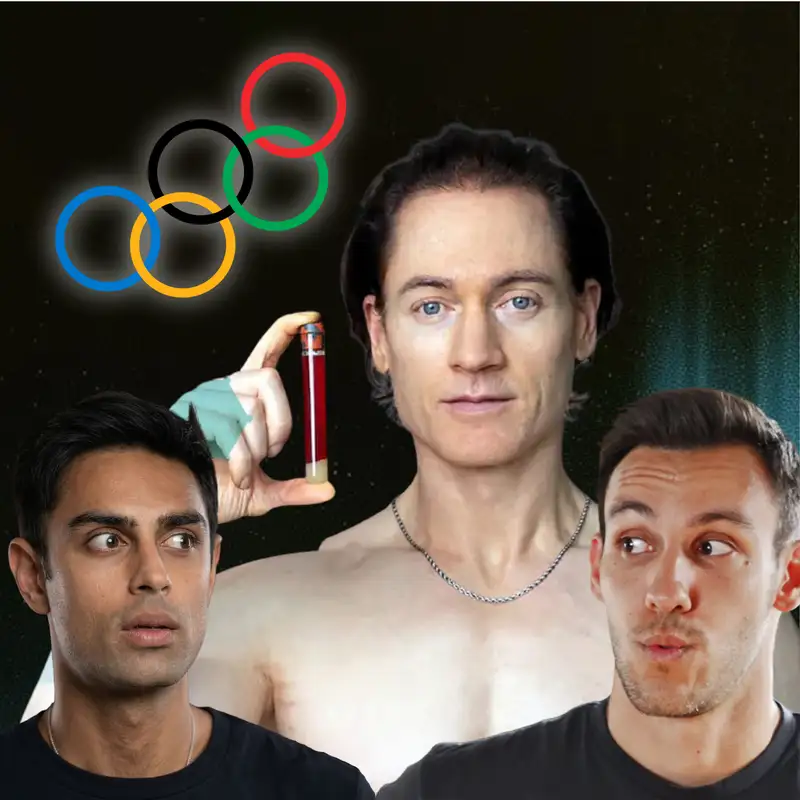
Encouraging Athletes to Take Steroids: Bryan Johnson's Enhanced Games
Josh:
So we have the regular Olympics, on this show we've covered the Robot Olympics,
Josh:
and now we have the Enhanced Olympics, an Olympic competition that just happened
Josh:
last weekend that offered $7 million in prizes to the top athletes in the world.
Josh:
But these are not normal athletes because the difference with the Enhanced Olympics,
Josh:
the Enhanced competition, is that you're allowed to take whatever performing
Josh:
enhancing drugs that you want.
Josh:
In fact, on screen you could see the before and after of what an Olympic swimmer
Josh:
looks like prior to the Enhanced Olympics, and currently afterwards.
Josh:
Words. He looks like a monster.
Josh:
This is a man that goes by the name The Missile. And on this episode,
Josh:
we're going to cover basically everything that went down at this new futuristic,
Josh:
pseudo dystopian Olympic event. We are fully kitted out in our athletic gear today.
Josh:
We are ready to talk all things superhuman.
Josh:
Is the ceiling actually higher because people dope? Or is there some unexpected
Josh:
outcomes that we're going to cover?
Josh:
I think the latter might be a little true, Ejaz. I know both of us were tuned into this this weekend.
Josh:
It's a really bizarre thing, but I think a really cool learning experience to
Josh:
see the impact that drugs have on super athletes.
Ejaaz:
Yeah, my social media timeline looked very different over the weekend,
Ejaaz:
and I couldn't figure out why.
Ejaaz:
This guy was plastered everywhere. His name is James the Missile Magnuson,
Ejaaz:
and he's an Australian swimmer.
Ejaaz:
He never actually won any kind of a significant medal at the Olympics, at least.
Ejaaz:
And he came back out of retirement to participate in these games. So what are these games?
Ejaaz:
Over this weekend, a bunch of billionaires got together, including Peter Thiel
Ejaaz:
and Balaji. and they said, okay, let's try and recreate the Olympics but have
Ejaaz:
no restrictions on doping.
Ejaaz:
So typically at the Olympics, we have something called the Anti-Doping Agency.
Ejaaz:
They have a set of rules of all performance-enhancing drugs and substances that
Ejaaz:
you can't use to perform at the highest level. So it's just human, no enhancement at all.
Ejaaz:
They took that and completely flipped the script, allowing pretty much anyone
Ejaaz:
and everyone to enhance themselves.
Ejaaz:
And the idea was, how far can we push the human body?
Ejaaz:
What records can be beaten when we use these different types of substances.
Ejaaz:
So it took place in Vegas.
Ejaaz:
There were around 36 events in total and a huge cash price, $7 million,
Ejaaz:
as you mentioned earlier on.
Ejaaz:
Now, the breakdown of this is pretty simple. If you break a world record being
Ejaaz:
on enhanced performance drugs, or if you just break a record in general, you win $1 million.
Ejaaz:
If you win your own embed category, you win $250K. So it really stacks up.
Ejaaz:
And I think this is like the largest payout of any sporting event in recent
Ejaaz:
history. So the way this played out was it took place in Vegas over the course
Ejaaz:
of four days, including the weekend.
Ejaaz:
And it takes place over three specific event categories.
Ejaaz:
So you've got swimming, you've got track, you've got weight lifting,
Ejaaz:
plus a strongman deadlift exhibition.
Ejaaz:
All of the athletes performing can be on performance enhancing drugs. But there's a twist.
Ejaaz:
If you want to perform and you are a previous world record holder and you don't
Ejaaz:
want to engage in any of the drugs, you can also do that and see how you fare
Ejaaz:
against the enhanced versions of these athletes.
Ejaaz:
$7 million on the line in total. And this was the first sanctioned drug doping
Ejaaz:
event in modern sports history.
Josh:
So we got to start with the answering the question that everyone wants to know,
Josh:
which is, does it actually make a difference?
Josh:
And on the surface, the answer is obviously yes. The first person we're going
Josh:
to talk about is this guy named Christian, I'm not going to try to pronounce
Josh:
his last name, who raced and won the 50 meter men's freestyle in 20.81 seconds,
Josh:
which is seven tenths of a second faster than the world record.
Josh:
So that was a really strong start. In fact, this was actually the conclusion
Josh:
of it. This was the last event.
Josh:
And Christian wound up taking home $1.5 million from the bonuses and awards that he won.
Josh:
Now for better or worse that is the beginning
Josh:
and the end of the world records that were broken there was only one it was
Josh:
this one it happened at the very end of the race and it poses a series of really
Josh:
interesting questions because another example that we have is this guy half
Josh:
thor and i think a lot of people know him as just the mountain that's his nickname
Josh:
and he is one of the world record holders for deadlifting he tried to do a world
Josh:
record deadlift attempt at the
Josh:
didn't work. He got very close. This is a painful video to watch because that
Josh:
is an insane amount of weight, 515 kilograms, and unfortunately could not get it lifted.
Josh:
And there was this one interesting counter argument, which was one of the people
Josh:
that actually won an event, totally natural.
Ejaaz:
I just want to go back to this Christian guy for a second.
Ejaaz:
So he's the only PED enhanced athlete that not only broke the record,
Ejaaz:
but came away with the most money, 1.5 million dollars he performed
Ejaaz:
in four olympics previously he
Ejaaz:
performed for greece and he didn't medal
Ejaaz:
a single time so this guy this guy that like has suddenly broken a world record
Ejaaz:
that has stood the test of time 20.81 seconds um was able to kind of prove the
Ejaaz:
thesis that like if you are able to enhance yourself you can achieve a higher
Ejaaz:
fit i also want to like take a moment to laugh at this for a second, this is like a disco.
Ejaaz:
This is like a club. You just never see this in the Olympics.
Ejaaz:
I just find that hilarious.
Ejaaz:
So other kind of medal winners that we have here, there's Cody Miller. He was a Vegas local.
Ejaaz:
He won the breaststroke event. We've got Fred Curley, two-time Olympic medalist.
Ejaaz:
He won the men's 100 meters race in 9.97 seconds.
Ejaaz:
He won 250K. He won the event, but he didn't break any kind of record.
Ejaaz:
Megan Romano on the female category, women's 100 freestyle. and Tristan Evelyn
Ejaaz:
won the women's 100 meters on track and Marius Cush won the butterfly event.
Ejaaz:
Each took home 250K each. So there was a bunch of very impressive feats,
Ejaaz:
fast and quick times, but not necessarily too many records broken.
Ejaaz:
And in the case of there being event winners, they actually ended up being ones
Ejaaz:
that won on performance enhancing drugs.
Josh:
And before we get into the all natural winner, we should talk about the rules
Josh:
that feels important or perhaps the lack thereof rules. Basically anything different
Josh:
that you could put into your body so long as it is FDA approved is allowed.
Josh:
It must be taken under medical supervision and every single dose and ingredients
Josh:
must be published prior to competing. That's it.
Josh:
Other than that, it's free range. And what we saw is that 62% of athletes actually
Josh:
stacked three or more of these substances on top of each other to chain the
Josh:
effects together, with the most popular one being testosterone.
Josh:
91% of the people who compete on this were on testosterone.
Josh:
We saw it in the clip of the missile and how big he got so quickly.
Josh:
That's where a lot of that comes from. Second to that is human growth hormone.
Josh:
79% of athletes did that.
Josh:
And then the third most popular, which I found interesting, were stimulants.
Josh:
62% of the athletes who competed use stimulants. That includes things like Adderall,
Josh:
which is an amphetamine. It gets you all hyped up.
Josh:
And also modafinil, which is another one on the list. I'm not super familiar
Josh:
with these, but there are a lot of risks that come with these,
Josh:
using these together, with compounding them. And the big question is,
Josh:
is like, are these worth it?
Josh:
And the answers that we received are a little questionable.
Josh:
Now we have these funny examples that I saw of people who really stacked these very hard.
Josh:
One of them, we have a clip from Brian Johnson here that we're gonna show,
Josh:
which talks about how one of the athletes, the missile, he actually took so
Josh:
many substances that he started sinking in the water because he became so dense.
Josh:
And it didn't quite work out for him that well because he came in last place, unfortunately.
Josh:
And it's funny, they were measuring these dosages and they had to start moving
Josh:
over to horse measuring tools because it set off the limit for what humans are actually allowed to do.
Josh:
And it's almost funny seeing how far these athletes will go with seemingly low returns.
Josh:
I mean, even down to the bathing suit, there's this really funny example of
Josh:
a video where one of these swimmers, it takes 27 minutes to actually get the
Josh:
bathing suit on their body fully because they have to include powder all over
Josh:
it and they need three people to help pull it up because they're very tight.
Josh:
It basically turns them into a seal. So...
Josh:
The optimizations for that final like 0.1% of edge are all in play.
Josh:
And it's just, it's really fascinating to see.
Ejaaz:
I'm not surprised to see Brian Johnson here commentating on this,
Ejaaz:
like he spends his entire life, his whole brand is just to kind of like optimize
Ejaaz:
his life for health and fitness.
Ejaaz:
And that's basically the thesis for this entire enhanced games,
Ejaaz:
like this enhanced Olympics.
Ejaaz:
It's like, how far can we push the human body and its limits to go to.
Ejaaz:
Now, it's interesting, I looked up the rulebook for these games, and there isn't one.
Ejaaz:
In fact, when you go into the official site, or any it's official Wikipedia
Ejaaz:
page, at least, it basically says it is the complete opposite to what the anti-doping
Ejaaz:
agency states for any kind of Olympic or actual sporting event.
Ejaaz:
So I found that pretty hilarious. And it brings up the question of like,
Ejaaz:
should humans be using these drugs?
Ejaaz:
Or should they not? Like, what's the moral ethic behind it?
Ejaaz:
Now, the obvious answer for many people or the majority of people will probably
Ejaaz:
be like, you know, you shouldn't be able to take a drug enhancing kind of like medication.
Ejaaz:
You should just kind of like perform in your natural fervor. But...
Ejaaz:
This has been kind of disputed a lot and it's actually changed a lot over time.
Ejaaz:
So if you look at like what the anti-doping agency kind of like positioned where
Ejaaz:
it positioned itself a decade ago versus where it positions itself now,
Ejaaz:
it's now enabled a bunch of different kinds of drugs or compounds to be used.
Ejaaz:
So it's always evolved over time.
Ejaaz:
And I guess the question that the Enhanced Games is trying to answer is,
Ejaaz:
should we have any of these rules in the first place?
Ejaaz:
Like what constitutes a safe substance? What constitutes an unsafe substance?
Ejaaz:
You'll see here like in the rulebook, they say that like, you can't use anything and everything.
Ejaaz:
And the things that are FDA approved, you need to state what substances you've taken,
Ejaaz:
what the doses dosages are so that they have a kind of like experimental lab
Ejaaz:
kind of feel like, I can't help but think that like, the sponsors for the show,
Ejaaz:
the investors for the show are biotech companies that are just doing as not
Ejaaz:
for the sporting history,
Ejaaz:
or the prominence that comes from that it's more to like, kind of like,
Ejaaz:
use them as lab rats to try and figure out, you know, what pads they should
Ejaaz:
be building themselves.
Ejaaz:
And there's a really interesting point that we want to make on the business side of things.
Ejaaz:
But before we do that, there is a narrative break.
Ejaaz:
So you would expect the people that use these different kinds of drugs to perform
Ejaaz:
better than the people that don't.
Ejaaz:
But that ended up not being the case, not just in one event,
Ejaaz:
but in many different cases. But let's just take this one example.
Ejaaz:
Hunter Armstrong shows up. He's a two-time Olympic gold medalist and a former
Ejaaz:
world record holder. And he performs in the 50-meter backstroke,
Ejaaz:
right? This is a very, you know, highly competitive event.
Ejaaz:
And he ends up winning it. He didn't take a single PED, performance enhancing
Ejaaz:
drug, and he beat all the guys, including, I believe, James the Missile Magnuson,
Ejaaz:
who is that beefed up guy that we showed earlier.
Ejaaz:
So it just goes to show that like, one of two things.
Ejaaz:
One, maybe the performance enhancing drugs don't actually enhance you for the
Ejaaz:
particular sport that you're trying to do. Maybe bigger muscle doesn't actually
Ejaaz:
help. It's more technique.
Ejaaz:
But then the other question that comes to my mind is, were the non-enhanced athletes
Ejaaz:
already on the drugs beforehand and maybe like they've just kind of like increased
Ejaaz:
it to a level that's kind of close to what is legal or illegal and they were
Ejaaz:
able to still win anyhow it's a it's an interesting question.
Josh:
There's like these two outstanding questions right one is that one that the
Josh:
actual games posed which is are olympic athletes already doping and they're
Josh:
just hiding it very well their assumption is yes their assumption is that 44
Josh:
of olympic athletes are actually doping as we speak and they're doing this on
Josh:
the regular basis and that's how they're getting exceptional results.
Josh:
Other side of this is that enhanced athletes
Josh:
don't even perform at an olympic level because it
Josh:
would effectively mean based on the results of this event
Josh:
that the physical ceiling of a lot of athletes is baked into more their genetics
Josh:
versus their ability to stack it on using growth enhancers because most of these
Josh:
races that we talked about they didn't even break olympic world records or they
Josh:
didn't even break olympic records let alone world records so a lot of the records weren't broken,
Josh:
even given the sheer amount of perceived advantage they would have from taking these drugs.
Josh:
And I think that's really noteworthy is the idea that possibly like humans,
Josh:
maybe you just need to be born as an elite level athlete and you could train
Josh:
to get to the maximum of your own potential, but taking a certain amount of
Josh:
drugs will not get you somewhere that you are not biologically able to do yet.
Josh:
And I think that's probably the takeaway from the first Olympic games is that
Josh:
you can maybe improve yourself a little bit, but based on the results we're
Josh:
seeing, I mean, people who didn't take any performance enhancing drugs were winning these events.
Josh:
And the only world record that was broken was one. And it was by seven tenths
Josh:
of a second. So it's very small margins here. We're right on the frontier.
Josh:
And there isn't a clear signal that taking all these drugs actually makes a
Josh:
meaningful difference.
Josh:
Now, granted, these are the FDA approved drugs. These are not the experimental
Josh:
peptides that we see a lot of people talking about.
Josh:
This is not that next generation of drugs. So we'll see how these games evolve
Josh:
over the years. But right now, the data is a little questionable.
Ejaaz:
There's this amazing quote from Fred Curley, who's a guy or athlete that competed
Ejaaz:
in the 100-meter sprint, and he refused to take any of these drugs,
Ejaaz:
and he ended up winning the event, despite not taking any of the drugs,
Ejaaz:
with a 9.97-second beat.
Ejaaz:
But he goes, he goes,
Ejaaz:
Everyone needs to train harder and use the drugs better too.
Ejaaz:
So the point he's making is like, essentially like drugs aren't everything to
Ejaaz:
win this kind of like type of an event or sporting competition at least.
Ejaaz:
And a lot goes into kind of like training and prepping yourself.
Ejaaz:
And we kind of see this with the people that like are very open and transparent,
Ejaaz:
but using steroids to kind of like enhance their physique, they do still put in a lot of work.
Ejaaz:
I kind of think of, I don't know if you know this guy, Josh, Chris Bumstead. he's
Ejaaz:
like this guy that's competed in a lot of like male um uh
Ejaaz:
olympics when it comes to like you know muscle mass and like those types of
Ejaaz:
competitions he's been very open about this kind of stuff and he puts in so
Ejaaz:
much work i've spent like so much time watching his youtube videos and stuff
Ejaaz:
and it's the same thing happening uh in these events like just because you take
Ejaaz:
these drugs doesn't mean you're automatically going to win you need to put in
Ejaaz:
the effort and you can get out competed by people who put in more effort than you yeah.
Josh:
They're freaks of nature and it's it's interesting to see. I wonder what would
Josh:
happen if we took those Olympic athletes and we gave them doping access,
Josh:
like the gold medalists of all these events.
Josh:
What would it look like if they were given a little extra edge?
Josh:
Would it make a material difference?
Josh:
I don't know. Maybe one day we'll see as this frontier gets pushed even forward.
Ejaaz:
Also, I want someone to come in that isn't retired for 20 years,
Ejaaz:
which is what a lot of these guys were.
Ejaaz:
I want to see them come out of their prime and use some of these drugs and see whether that works.
Ejaaz:
I guess a lot of that is dependent on like future versions of this competition.
Josh:
Yeah. And then there's this whole second part of this competition too,
Josh:
which is getting down to the kind of reason why this even exists in the first
Josh:
place. We mentioned Peter Thiel is one of the elite investors.
Josh:
This took place in Vegas. This also, one thing that's noteworthy that we haven't
Josh:
mentioned yet is the fact that it took place in Vegas outside in the end of May.
Josh:
It was hot, so hot that they had to cover the barbells because they were getting too hot to even hold.
Josh:
A lot of athletes, they train and very controlled indoor environments.
Josh:
So having to compete outdoor in the very, very high heat, fully exposed to the sun
Josh:
is a disadvantage. But the business that put this on is, I think,
Josh:
part of the story that a lot of people are glazing over.
Josh:
Because this very much is a business. This is not just a for-fun philanthropic
Josh:
venture. This is a company with a goal.
Josh:
And that is clearly based on their website to sell you supplements or to actually
Josh:
trade at a higher valuation because it's public.
Josh:
But Ejaz, you were scrolling through the website earlier to just get a little bit more information.
Josh:
And it's funny, the first thing that you see when you visit the website is a
Josh:
button that says get enhanced and they're selling a series of performance enhancing
Josh:
drugs that you can go and buy based on this brand.
Josh:
So it's interesting to note the economic incentives as well for holding an event like this.
Ejaaz:
Yeah, you would think that when you go to a sporting athletic associations website
Ejaaz:
that they would probably talk something about the competition and like explain
Ejaaz:
kind of like the philosophy, the thesis, the vision behind this entire thing.
Ejaaz:
It's one of the greatest competitive traits of history. And over here,
Ejaaz:
they're just trying to sell your product.
Ejaaz:
I don't even know what these products do, by the way, but they're trying to
Ejaaz:
sell you the products that these athletes are taking you as a regular individual
Ejaaz:
that may not be competing at the highest level or have any interest in competing
Ejaaz:
at the highest level, you're immediately hit with a get enhanced button.
Ejaaz:
And you can view this menu of these random compounds, which most of these compounds,
Ejaaz:
I don't know how to pronounce, I don't know what they will do.
Ejaaz:
And you can buy it in the same way that I buy my protein powder,
Ejaaz:
and I have it on subscription, and you can take it.
Ejaaz:
I don't know what effects these will have. But the point is,
Ejaaz:
this seems like a biotech company advertising their product disguised as a sporting event.
Ejaaz:
And that kind of takes away from the authenticity and the excitement that comes
Ejaaz:
from this and reinforces the point that I made earlier, which is this seems
Ejaaz:
like a worldwide kind of lab experiment
Ejaaz:
to try and see whether their drugs actually do do well and if not,
Ejaaz:
what went wrong and how they can improve it. Maybe they do genetic testing and
Ejaaz:
all those kinds of things.
Ejaaz:
And so another thing I discovered is if you go to the investor tab of this website,
Ejaaz:
you'll notice a stock ticker.
Ejaaz:
On the left over here. And so I was like, what is this? What is this stock?
Ejaaz:
Why is this company public?
Ejaaz:
And it turns out it is the enhanced games is basically part of a SPAC.
Ejaaz:
So they were like acquired under the ticker, E N H A.
Ejaaz:
And they basically started effectively trading about a couple of months ago.
Ejaaz:
And in the last month, it has taken an absolute beating.
Ejaaz:
The complete value of this entire corporation is down almost 50%.
Ejaaz:
So it signals a few things.
Ejaaz:
One, that the general public's confidence in this type of competition isn't
Ejaaz:
too high, isn't too favorable, which I guess makes sense.
Ejaaz:
The majority of people are used to the Olympics. They care about ethics and
Ejaaz:
they care about the fact that like these humans are performing in their natural form.
Ejaaz:
People aren't really open to PEDs or they're not really, they have a bad taste
Ejaaz:
in their mouth about like what these things actually do. They see it as a bad thing.
Ejaaz:
But just interesting to see the financial incentives that are put in by these
Ejaaz:
full billionaires, Balaji, Peter Thiel, and a number of others that are trying
Ejaaz:
to kind of boost this mainly as a sales narrative versus a sporting achievement.
Josh:
Yeah, and I wish the stock was actually the other direction because I think
Josh:
it's very admirable trying new things, shifting the Overton window in ways that
Josh:
a lot of people don't expect, making it acceptable to test and experiment on yourself.
Josh:
And this is very much, I mean, we talk a lot about AI on the show.
Josh:
This is very much a world that gets empowered and accelerated by AI.
Josh:
I think when we think about a lot of the largest investments that are coming,
Josh:
right now, even from within OpenAI and Anthropic and other large companies like
Josh:
Eli Lilly and Andreessen Horowitz,
Josh:
they're all spending a lot of time figuring out the best ways to contribute
Josh:
to the world of biotech, to understanding genome sequencing,
Josh:
to investing in biotech accelerators, anything that can really move the needle forward.
Josh:
In fact, Eli Lilly and Andreessen Horowitz launched a half a billion dollar
Josh:
fund just for AI biotech to help accelerate the rate at which we discover these
Josh:
new breakthroughs. And one of the things that we're gonna be seeing
Josh:
as we progress through this, is the increased cadence of trials that not only
Josh:
go to trial, but then pass trial, because we're able to do so much of the testing
Josh:
through these large language models versus having to wait for human trials that take many, many years.
Josh:
So the rate of acceleration that we're going to see these types of improvements,
Josh:
maybe now just for sport, because it's fun to watch, but then also for just
Josh:
general well-being of humans, it's probably going to accelerate fairly quickly.
Josh:
And all of these initiatives are all pushing the same direction.
Ejaaz:
And I think you're right. And I don't think it's just going to surface in the form of athletics.
Ejaaz:
It's going to surface in the form of self-care and even like prevention of diseases
Ejaaz:
forming or even just treating diseases directly.
Ejaaz:
I think immediately of isomorphic labs, which is basically Google's AI-powered
Ejaaz:
drug lab, which just spun out and raised, I think, $2.1 billion from Thrive.
Ejaaz:
Their whole thing is they attach
Ejaaz:
Google's like leading protein sequencing model to a drug design module.
Ejaaz:
And it basically spits out, it evaluates your genome, it sequences it,
Ejaaz:
and then it spits out a perfected cure design of a drug that could prevent major
Ejaaz:
diseases from occurring.
Ejaaz:
Now, the one major kind of like feat that it's achieved so far is the drugs
Ejaaz:
that it's designed, that has been tested and built in a lab,
Ejaaz:
have already passed a number of the different obstacles, way more than an average
Ejaaz:
drug does, for testing to go to human trials.
Ejaaz:
So the technology is already proving itself.
Ejaaz:
Just a bunch of these drugs haven't hit the public market yet because they're
Ejaaz:
going through human trials right now.
Ejaaz:
So I expect there to be a shift in the future where people go from like not
Ejaaz:
having certainty around how to treat a particular disease or problem or cure
Ejaaz:
to having full confidence in doing that. And in fact, leaning into it.
Ejaaz:
If you could have a personalized drug for yourself versus for me,
Ejaaz:
for some particular ailment that we're feeling, that is something that will
Ejaaz:
not just permeate the drug and disease side of things, but also performance
Ejaaz:
enhancing as well. It's easy to kind of like make that jump in your head to go from,
Ejaaz:
well, if I can prevent this disease, how can I make myself better?
Ejaaz:
I'm like, I don't have a disease right now, but can I improve my hair growth
Ejaaz:
or whatever that might be?
Ejaaz:
And so you can see something like the Enhanced Games becoming a lot popular
Ejaaz:
down the line, thanks to AI.
Josh:
Yeah, and fun stats in terms of AI acceleration. We're about halfway through
Josh:
the year of 2026, and so far, 173 AI drug discovered programs are in clinical trials right now.
Josh:
94 are in phase one, 56 are in phase two, 15 are in phase three,
Josh:
all enabled by AI. This is a huge rate of acceleration.
Josh:
In fact, Anthropic, they acquired Coefficient Bio, if you remember a little
Josh:
while ago, for $400 million of stock.
Josh:
So Frontier Labs are trying to solve this problem, which is mostly now a large
Josh:
numbers problem because I think the estimate is 10 to the 60th power possible
Josh:
chemical compounds exist, which is more than the stars in the observable universe.
Josh:
And now it's these companies' jobs to seek out that problem space,
Josh:
figure out where the best solutions lie, and actually bring those into a form
Josh:
factor that humans can ingest to make their lives better.
Josh:
And if these enhanced games can accelerate the rate that that happens or the
Josh:
attention that gets placed on it, I think that's a huge win for everyone,
Josh:
even if the records were not really broken this one.
Ejaaz:
I think it's a good start. I actually do want to see more of this happen.
Ejaaz:
I have a bio background, so I kind of like dug into the weeds of a lot of this
Ejaaz:
genetic stuff in the past and I'm like massively pro, like trying to figure
Ejaaz:
out new ways and new cures or novel ways to kind of enhance the human body.
Ejaaz:
When it comes to sporting i i expect this trend to
Ejaaz:
flip um i was kind of surprised that the drug enhancements didn't work
Ejaaz:
but it may also make sense like they have never had like
Ejaaz:
a wide test bucket to kind of see how humans actually perform at the highest
Ejaaz:
level and it was just a great spectacle to watch over the weekend um it definitely
Ejaaz:
kept me super entertained i sent a bunch of these to my friends who were like
Ejaaz:
that you know these kind of records being broken are crazy um and it was just
Ejaaz:
a fun discussion overall for for i think like uh
Ejaaz:
people who are kind of obsessed with sports or athletics or like even kind of
Ejaaz:
interested and wanted to see, you know, how far can we actually push this?
Ejaaz:
It's been great entertainment all round. And I'm looking forward to the next
Ejaaz:
one. I'm excited to see like what some of these products actually do for regular people as well.
Ejaaz:
If you are someone that is listening to this and you go onto their website and
Ejaaz:
you're seeing some of these comments and you're interested in it,
Ejaaz:
like, let us know what your thought process is behind it.
Ejaaz:
Because I look at this and I'm kind of like scared, but maybe you guys know
Ejaaz:
something better than me.
Ejaaz:
I know peptides and amino acids are becoming like a big thing now.
Ejaaz:
So maybe I'm just a boomer and missing something.
Ejaaz:
But that is it for today's episode.
Ejaaz:
We have a bunch more coming up this week. Josh, any final words?
Josh:
No, that's it. I mean, it was a fun weekend. If you haven't seen some of these
Josh:
clips, I would recommend going back, checking them out, watching them.
Josh:
If you enjoyed this episode, don't forget to share it with your friends.
Josh:
Your support really helps. We have been having record weeks the last two weeks in terms of you.
Josh:
So thank you so much for the support. As always, we really appreciate it.
Josh:
And we will be back again tomorrow for another episode.
Ejaaz:
See you guys.
Creators and Guests