AI Just Saved SpaceX: Record $14.6B Quarter, First Profit and a Tesla Merger
I am excited. SpaceX, four months ago, had the largest, most expensive IPO in
history, and half of Wall Street basically wrote them off.
They called the company massively overvalued, and yet last night they reported
their quarterly earnings and a massive $14.6 billion in revenue in a single quarter.
That is more money than they made in the entirety of last year.
But what's most interesting is how they made that money.
SpaceX, as its name suggests, is a space company, yet they made the majority
of their money through AI.
Their business line has tripled over the last three months, eclipsing Starlink for the first time ever.
And the reason why they've been able to pull this off is because they've become
the number one neocloud, the number one provider of compute to some of the biggest
labs and companies in the world, including Anthropic and Google,
selling billions of dollars worth of compute per month.
And it turns out compute is an incredibly lucrative business.
Elon Musk is projecting $500 billion to $1 trillion of ARR next year,
in one year, 2027. But don't just take his word for it.
JP Morgan also backs this up and has given them a new price target of $500 per share.
There's a lot of big numbers that we're throwing around here.
And I dug into the entire earnings report, but also the wider strategy,
which I'm really excited to jump into because it includes a merger between SpaceX and Tesla.
And there's a lot of reasons why these companies should merge and eventually
make them the fifth most valuable company in the entire world.
So let's get into all of this on today's episode brought to you by Qualcomm.
Now, four months ago, we made an episode covering the SpaceX IPO.
And back then, things looked a little bit precarious.
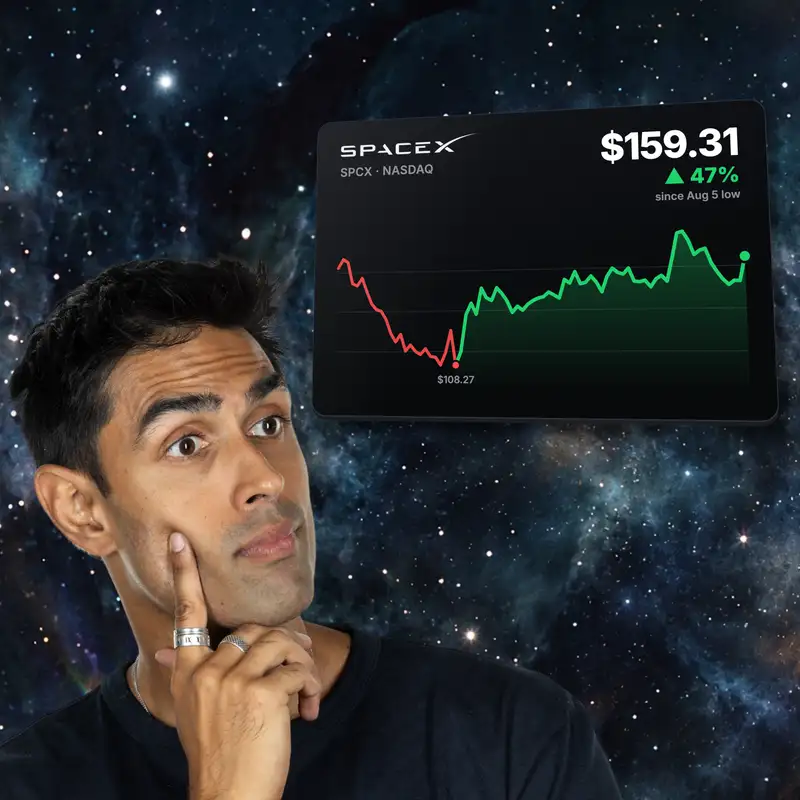
They IPO'd at $135 per share.
The stock then sent to, I think it was $171. And then it proceeded to dump more
than 50% over the subsequent few weeks.
Wall Street was incredibly bearish and for good reason, because SpaceX couldn't
demonstrate how exactly they were going to make money.
Space was obviously a really good vision, but they had a long way to go to kind
of like prove the rocket tests and get to the point where they could launch
a rocket back and forth multiple times per day.
But something happened in the last couple of months that changed all of it and
it was a simple pivot by Elon Musk which was they acquired xAI.
And they acquired the most compute out of any AI company, or just company in general, out there.
They acquired the largest amount of GPUs, which they now house under their three
core data centers, Colossus 1, Colossus 2, and Colossus 3.
Now, these GPUs were meant to serve Grok, except that Elon Musk couldn't quite
get it to work just yet. And in the meantime, he had a bright idea.
He decided to rent that compute out to people who needed it,
the likes of Anthropic, who are now paying them $1.25 billion per month,
and Google, who is also paying about a billion dollars per month.
And Elon figured that because he was the quickest to be able to scale compute,
quicker than any other company out there, he could charge a premium.
Now, at the time of recording, the stock is up about 9%. But I want to get into
the actual numbers from the quarterly reports and what that actually tells me
about the company and where they're headed.
So some of the headline numbers, $14.6 billion of revenue compared to last quarter, which is up 161%.
Absolutely huge. But the most important point to take away here is that it largely
derived from AI. The AI segment alone pulled in around $7.6 billion.
Which is up 830% from last quarter.
Now, there's a few things to take away from these numbers. Number one,
it's eclipsed Starlink revenue. And this is a big deal because Starlink has
for a while been the a major revenue earner for SpaceX. It's eclipsed it in a pretty big way as well.
Number two, this officially gives SpaceX the first time in its history of achieving a profit.
And Elon is, as you can expect, doubling down on this.
This quarter's capex spend was $19.6 billion, and he's aiming for 35 to $40
billion next quarter. But what I find most fascinating is how this is going
to translate into revenue for the company, because the projections.
Are pretty hefty. By the end of the year, SpaceX plans to have around 3 gigawatts
worth of compute online, which is impressive.
But what's more impressive is the projection for next year, where Elon estimates
they'll have around 10 to 20 gigawatts worth of compute.
Now, there were obviously other highlights of the earnings, including StarMind,
which is their AI satellite network, which they're launching loads of exciting
details there, as well as TeraFab, which is the largest chip manufacturing
plant that will ever exist if it comes to light.
But the number one story here is how did SpaceX become the number one neocloud in the world.
When they're a space company? Well, the answer simply is Elon and the company
is the number one scalar or physical scalar in the entire world.
The business of being a neocloud is very easy to understand,
right? You buy GPUs, mainly from NVIDIA. And by the way, SpaceX and Elon is
one of the, if not the biggest purchaser of NVIDIA GPUs.
So once you have those GPUs, you house them in a warehouse known as a data center.
You plug in all the different cables, make sure temperature is regulated,
make sure there's enough power and energy to feed these GPUs.
You bring those GPUs online and then you either decide to do one of two things.
You either use it for yourself to train and inference your own models or you
rent it out to competitors or people who want that same inference and compute
and make a hell of a lot of money out of it.
Now Elon and SpaceX tried the first option with Grok and listen they're making
good progress but not quick enough progress to warrant investing all of this money into compute.
So Elon had a light bulb idea. He was like, I'll just sell any excess compute
that we have to make enough money to still fund all the other things that I
want to do. And maybe even I'll turn a profit.
And then he looked over the fence and he realized, huh, OpenAI and Anthropic
are really struggling to bring compute online.
They looked at Meta and he said, they're not doing that bad.
Looked at Google building their own TPUs and were like, good luck with that.
I'm just going to buy from the best maker and provider of GPUs,
Jensen Huang, NVIDIA, and then I'll be the quickest one to do it.
And I'll gain such a huge marginal lead on everyone that I'll have so much excess
compute to either decide to train some of the best models in the world,
or I'll just sell it to my competitors.
And you have to understand, Musk is a master at this, and that's not an exaggeration.
He's bringing online 200,000 GPUs per month.
That is around $13.1 billion worth of heavy metal machinery,
fund this whole AI CapEx build out online per month.
No other company is doing this. And when he was asked about how he was able
to do this, his answer was pretty hilarious.
He said, I'm spending four days a week there. I'm sleeping on the manufacturing
site floor, and I'm at the Colossus 1, 2, and 3 data centers in Memphis,
trying to bring all of this online and making sure it gets done.
What's even crazier is that's not even the hardest part.
The easiest part actually is buying the GPUs and bringing them online the harder
part is where do you get the land power and electricity,
to turn all of these things on because i've mentioned this on previous episodes
one of the key constraints and bottlenecks in the AI race right now is,
not buying the GPUs it's switching them on it's powering them on it's getting
the electrical grid energy and enough of it.
Not surpassing all the red tape of regulatory burdens to feed your GPUs.
Amazon actually said this week that they have billions of dollars worth of GPUs
that are just collecting dust. Microsoft has the same issue as well,
because they haven't got the permits, they haven't got the turbines,
they haven't got the energy grid to try and figure this all out.
This is something that Elon Musk has been hyper-focused on for the last year.
And I'll tell you a crazy fact, they have repurposed rocket workshops at SpaceX
to build turbines to use in generators, makeshift generators,
that they run behind the meter or on-site at these data centers to
overcome the obstacles or challenges of requesting electrical grid access.
This is the 3D or rather 4D chess that Elon and SpaceX are playing against their
competitors, which have allowed them to get a 12 to 18 month lead on compute
against their nearest second place competitor, which I think is Meta.
So it's because of this vertical integration that Elon has just obsessed over
that he's been able to pull off one of the biggest feats that may give SpaceX
a chance to be a frontier AI lab or one of the top frontier AI labs in the very near future.
But he has all the excess compute, right? And yesterday's episode covered CoreWeave,
which also had a lot of compute.
But people were questioning whether there was actually any real demand for these things.
Elon answered that on the call yesterday. He said, we get a knock on the door
so many times every single day from some of the biggest companies in the world
asking for access to the compute.
He said if he had multiple times the amount of compute that he has online today,
he would have been able to sell that compute several times over.
But the craziest part about this is that SpaceX is charging the premium price
on every single watt of data that they sell.
So right now, Elon, I think, sells between $50 to $60 per watt annualized a year.
Now, if you scale that out to the conservative estimate that they have of 10
gigawatts next year, that brings you to the $400 billion ARR estimate that I mentioned earlier on.
But don't take my word for it. You have Anthropic paying them $1.25 billion.
A month. You have Google paying them $965 million a month. Call it a billion.
And then I think you have Reflection AI that committed $6.3 billion to get as
much compute as they can from Elon Musk.
The craziest part about this is even though he's selling them all of this compute,
he is still able to have excess compute to train a frontier AI model.
I think the next Grok model that is going to come out by the end of this year
is going to be a 10 to 15 trillion parameter model, which let me tell you,
requires a lot of compute.
And the way he's been able to do this is by selling short-term leases on this
compute. So typically, if you're Anthropic or OpenAI, you want to sign a long-term
agreement with a compute provider so that they can guarantee that they have
enough compute to train and serve all their models.
Elon Musk, because he's technically a competitor and he wants to build his own
AI model, is saying, listen, I'll sell you the compute, but only for short-term
contracts like three to six to nine to 12 months at a time.
But I'm also going to charge you a premium to do that. And that's what he's
been able to pull off because all of these customers are paying that price.
So the demand is in excess of the amount of compute that is available and physical
atoms are constraining people for bringing these GPUs online.
But Elon Musk has found a way to circumvent a lot of this and he's so far the
only company that has been able to pull this off. So,
a few things are contingent on this actually being realistic.
Number one, Elon is able to continually bring on compute in the manner that he has.
And he's going to run up against a lot of friction here.
He's going to run up against grid constraints. He's going to run up against
manufacturing constraints, like cool that he's building his own gas turbines
and stuff, but that's going to reach capacity at some point.
Is the demand going to still exist? Right now, he can charge a premium because
there's not much compute available. But what happens when, I guess the market
becomes flooded or maybe another competitor figures out a way to scale in the
same way that SpaceX has done so far.
And on top of all of that, there's just constraints in manufacturing these GPUs in the first place.
I mentioned the $35 to $40 billion CapEx spend that SpaceX alone is planning
to spend over the next three months. So we'll see how that goes.
We'll see how much Elon is able to acquire and bring online.
There's still definitely some red flags here.
If this quarter's earnings is anything to go by, it's looking optimistic.
So if you're looking at this purely from an investment perspective,
my own take on this is we're looking a lot more optimistic than we did three
months ago, but still tread cautiously. Remember, SpaceX has the craziest share
unlock schedule of any other company that we've ever seen.
Typically, you see a one-year cliff and then everything starts to unlock.
The cliff started within a few weeks of the company IPO-ing and they have like
kind of this weird hierarchy of price targets where if a valuation target is
hit, then more shares unlock. It's something to be aware of.
It's not just all what the news reports. So definitely tread carefully because
obviously flooding the market with all this excess amount of shares is going
to create the issue of having enough purchase demand to keep the price where it's at.
But there's also a number of other things that Elon brought up pertaining to
other parts of the business, including one big one, the merger between Tesla and SpaceX.
The rumor mill around this started well before SpaceX even IPO'd,
but Elon finally commented on this entire thing, which gives me a lot of positivity
about the potential of this happening, arguably maybe by the end of the year.
So let's get into it on today's episode brought to you by Qualcomm.
Now, the key sentence Elon delivered on this was, by the request of shareholders,
both companies have formed special committees to discuss the potential of a merger.
So you have shareholders and board members, presumably, from Tesla and from
SpaceX that are now huddling and having conversations about what this merger
would look like and whether it's actually feasible.
But there's one important point. Elon, because he has obvious conflicts of interest,
cannot be involved in these meetings.
And when he was asked whether he thought this was a good idea,
his answer was simply yes.
And it was yes for a very good reason. Because when I think about the synergy
of Tesla, a car automotive company, and SpaceX, a space company that's kind
of doing AI stuff and creating some kind of nebulous StarMind satellite network,
the connection doesn't seem quite clear.
So let me try and do my best at explaining what the obvious synergies are.
Number one, SpaceX is trying to make transport to space in and out of space,
actually, the cheapest possible thing alive.
So basically, they'll effectively own the highway of getting things into space.
But then the next natural question is, so what? What do you want to do in space?
What are the products in space? Well, number one, it's Starlink.
Starlink is basically a distributed network for connectivity to the internet,
for any device and any human on Earth and maybe off of Earth.
So the idea here is it's a network that would beam internet down to Earth.
Across all dead zones so that you can be connected to the fastest,
cheapest internet ever.
And so that you don't have to be reliant on telecom infrastructure companies
that have myriad different issues between themselves.
But then you have StarMind. StarMind is their AI satellite network,
which is currently being custom built with NVIDIA and also what's going to be
a large product from the TeraFab thing, which I'll get to in a second.
But the idea here is you'll be able to launch a specialized AI satellite launched out towards the sun.
It harnesses the energy of the sun and is able to inference and or train AI
models up in space, which sounds completely crazy because there's a lot of constraints, right?
There's the radiation issue. There is the how the hell is it going to be survived
and maintained out of there? There's the big question around how these GPUs talk to each other.
Over the last year, SpaceX has been thinking very deeply about this,
and they've been able to figure out some really convincing prototypes.
But of course, the big question mark is whether they'll be able to do this at scale.
According to the timelines that Elon has cited, we'll be able to see versions
of this come alive next year over the next 12 to roughly 18 months.
But the vision here is you would have, similarly to Starlink,
a network of AI satellites out there harnessing the power of the sun,
very Kardashev Type 2 civilization, at the cheapest possible rate.
Now, bear in mind, if you want to get your hands on that kind of energy,
one, you run into a lot of red tape.
Two, the cost for this thing is crazy. And three, it's governed by so many different
parties that it's just a pain to deal with.
So Elon's solution to this is project the GPUs out towards the sun,
harness all that energy 24-7 for the cheapest rates possible,
and then compete with all the data centers, compute providers,
and energy providers down on earth. And the idea here is that.
There is no competition. If Elon is able to transport these GPUs out there,
create that network, and in fact, harness all that energy, they will end up
with the best offering ever.
And if anyone wants to compete, they need to go through SpaceX.
So it's this crazy vertically integrated stack that would help create connectivity
to the internet via Starlink and connectivity to the cheapest compute inference
and training for any AI model.
And that could be Grok, but that could be also for all the competitors that
Elon Musk and SpaceX is currently selling compute to
imagine Anthropic in the future they don't want to spend crazy prices for very crappy
compute on earth they would just pay Elon and Elon can charge a cheaper price
but still make wider margins because he has it at a cheapest cost versus any
of his competitors okay so what does this have to do with Tesla
well Tesla creates all the devices and i use the term devices very specifically.
You might think that a Tesla car is a car and very much it is,
but it's also a computer, a computer that is connected to other computers, other Tesla cars.
And we have currently millions of Tesla cars roaming the earth.
A lot of them have full self-driving capability, which means that it can autonomously
drive better than 99% of humans on earth.
So the idea here is it has cameras and sensors around it.
It is a computer that is fully functioning. You can run Grok or the Frontier
Grok AI models in the car right now.
You can connect it to any of your devices, any of your apps.
It creates this coherent system, almost like Jarvis from Iron Man, right?
And so you need physical infrastructure and devices to be able to serve all the AI.
And in order to serve all that AI, and in order to connect all these different
software products to humans, to what we're interacting with, you need internet.
So it makes sense that all of these Teslas, all of these Optimus robots,
these humanoid robots, and any other device that Tesla builds can be one,
connected to each other on Earth, and two, connected to the number one cheapest
AI inference service provider.
And the internet. And if you're SpaceX, remember you have that thing called
xAI and you are training your own AI models.
So what do you need to train the best AI models? It's not just compute, it's also data.
If you look over at Tesla, Tesla has all the camera and sensors that are pulling
in data 24-7 from around the world wherever Tesla operates.
And so feeding that data into the model can be incredibly valuable for future
model iterations. But there's also a lot of manual labor that needs to be figured out.
Humans, for all intents and purposes, are limited. You need to train them from
scratch. You need to make sure they're qualified to be able to build and do
the thing around data centers, around AI models.
It is a scarce resource. But imagine if you could automate at least just the
physical labor side of things.
You could do that via the Optimus humanoid robots. Now, of course,
I'm speaking at a very great length of time in terms of like making these things happen.
It's not going to be easy to pull off. But the idea here is,
if you end up in a world with hundreds of millions, maybe even billions of humanoid
robots that can automate a lot of the physical labor.
And then you can own the compute and maybe even the data that you can deliver
to create the best artificial intelligent models in the world,
and then you can pair them together,
you end up with effectively what is a superhuman system that can help advance
humanity well beyond where we're at today.
But there's one more thing holding them back. Chips.
You need physical hardware to house the brain for all of these different things
whether it's the AI model to train and inference it or whether it's the humanoid
robot or the car to power it who's going to build those chips could be NVIDIA or it could be
whatever the merger of SpaceX and Tesla is which we've seen very clearly most recently
TeraFab. TeraFab is basically the most ambitious effort to try and build the
biggest chip plant specifically for AI and compute and devices in general on earth.
As you can imagine if we do have that world of a billion robots whether that's
cars or humanoids and then we need enough compute to power all those things
you're going to need billions of chips
and right now if you combine Nvidia or any of the other chip fabs such as Intel or AMD.
You're not going to get anywhere close and And if you are one company that is
reliant on producing a lot of these things and needing those chips,
you may not want to rely on those companies who could price you out or whatever.
So the best way to figure this out is to vertically integrate it,
which is why this is such an ambitious effort. And he commented yesterday on
the first phase where he said $16.8 billion in the first phase,
100,000 wafers a month before 2030.
But at its peak, 1 million wafers a month within 10 years, which will also create
around 3,000 plus jobs. It's currently doing that right now.
Now, I want to end this episode by bringing myself down to earth and grounding
myself for a bit because I want to be clear here, there's a lot of ways that
this could potentially go wrong.
My list here is capex of $35 billion to $40 billion. Where are you getting that money from?
Last time I looked at Tesla's balance sheet, they had about $43 billion.
Is he going to self-finance it or is he going to raise more money?
Rumor has it is he's trying to raise more money right now to the tune of $30
to I think $50 billion before the Anthropic IPO. I don't know how far he's got
along with that, but the point is he's trying to raise as much money as he can to fund that CapEx.
That's still a big red flag. He may not be able to pull this off and if he doesn't,
it's going to delay or at worst, stop any of these efforts entirely.
Number two, transitioning from GB300s, which is where the bread and butter is,
bringing on 200,000 online every month, to Vera Rubins might actually be way
more difficult technically.
Now, NVIDIA or Jensen Huang went on stage yesterday, or maybe it was this morning,
it was in Europe, in Germany, in Berlin at GTC, and he went on and said,
this is the easiest GPU to bring online.
So it's not only the smartest, but the easiest. It takes around five minutes,
no cables. its self-contained cooling system.
Now, I don't think that's strictly true, and obviously he's probably being very
lenient in his explanation, but if history is anything to tell us,
it takes a while to actually bring the next-gen GPUs online once they've actually been produced.
So this may further delay things. And then the final thing is obviously you
have to take Elon's estimate with a huge grain of salt.
You have J.P. Morgan on one hand predicting $254 billion of revenue next year, which,
granted, is huge for SpaceX, who previously forecasted a massive amount of revenue
but had no way of justifying it, then versus Elon's conservative estimate of
$500 billion to $1 trillion of next year.
A lot of it remains to be seen. I'm going to be sat here regardless with my
popcorn watching all of this unfold.
And I just want to say it is crazy to be talking about these figures at length realistically.
If we wind back even five to 10 years, the notion of making $15 billion in three
months was almost unheard of.
Definitely reserved for just one or two companies at the time.
And now we're seeing this happen to new companies that pop up after the most
expensive IPOs or even private companies such as Anthropic and OpenAI who are
rumored to be making IPOs.
Tens of billions of dollars per quarter that are going to be having blockbuster
IPOs themselves over the next couple of months. I heard that Anthropic potentially
files publicly at the end of this week.
It's insane. So that is the episode. The earnings dropped last night.
I was up all night. And hopefully this was helpful to you. If you enjoyed this
episode, give us a thumbs up.
There's actually a lot of newbies here, a lot of new people that have signed
up and subscribed and are watching our content. Thank you so much and welcome.
This has been a whirlwind of a journey building up this channel and building up all this content.
But I'm trying to bring the kind of best takes, news, insights on all the things
happening in AI and frontier tech every single day.
And one final point I'll leave you with is it's funny making the episode that
I did yesterday, which was about CoreWeave, who's also in Neocloud,
struggling to justify their valuation and tanking the entire stock market
versus SpaceX that is doing arguably the same thing just at a much larger scale.
And maybe they have the money to back it, but they have crazier forecasts for revenue.
And there's a much more positive reaction because they're generating so much revenue.
The demand is obviously there. People are paying for this compute.
People want to be building AI
models and serving it to others and building different products off of it.
So there's just this weird dichotomy that exists right now where the market is tentative.
They're worried that we're in a bubble. And then you have SpaceX kind of proving
that the revenue aspect, at least in the interim or over the last three months,
is very much there. So it'll be exciting to see all of this play out and I'll
see you on the next episode of In The Loop brought to you by Qualcomm.
Creators and Guests