CoreWeave's Crash Looks Like 2008. Here's Why It Isn't.
So last week, someone posted a chart online and the entire stock market crashed.
CoreWeave was down 15% in 24 hours. Dell was down 11%. Oracle down 9%.
In fact, semiconductor stocks were down for eight days in a row,
which was the longest losing streak since 2008, where we all know there was
a big financial crash. But the thing that puzzles me the most is there doesn't
seem to be a reason for this crash to even happen.
CoreWeave reported their best revenue earnings up 112% from the year before
and $129 billion revenue backlog backed by some big names, Microsoft,
Meta, and maybe even Anthropic.
If we look at Dell, Oracle, TSMC, they reported their best quarters in history,
but their stock still fell.
When you talk to Andy Jassy from a quote from an interview last week,
he reported that demand has exceeded supply beyond 2028.
So he's dealing with capacity constraints for 2029, years in advance.
So why then are these companies' stocks failing? We're going to get into why
the market is recently dumping the whole CoreWeave debacle and saga on today's
episode brought to you by Qualcomm.
Now, typically when the market crashes, there's always a number of different
factors that are happening.
But in this case, it's just to do with one single company and how much they've
borrowed to fund their GPU expenditure.
Now, CoreWeave, as you probably already know, is what you would call a neocloud,
basically a cloud center or an owner of multiple data centers that house GPUs.
They rent these GPUs to major AI labs or other hyperscalers so that they can
run inference on AI models or train AI models. And CoreWeave specifically has
seen a pretty meteoric rise over the last three to four years.
They IPO'd last year. Their stock has been doing relatively well.
But CoreWeave pivoted. They were originally a GPU company that just served gaming.
And then they pivoted into crypto mining back when Bitcoin mining was a huge thing.
And then when AI exploded, they were like, hmm, I could repurpose these GPUs simply for AI models.
And they ended up getting the biggest valuation and making the most money than they ever had before.
And there's been a number of other neoclouds that have popped up,
such as IREN, Nebius, Nscale, all which have reached pretty crazy valuations
and their revenue catalogs have basically looked like this.
Over the last year and a half as the likes of Anthropic, OpenAI,
Meta, Microsoft, Google, Amazon have all signed multi-billion dollar multi-year deals with them.
So then what's changed over the last couple of days or weeks that have caused
the market to react in this way?
Well it all started with one single tweet from Chamath Palihapitiya who is one
of the hosts on the All In podcast which I love but also former Meta exec that
did pretty well, started his own fund, Social Capital, and I think he stepped away from that.
And now he just has really good takes on the AI market and macroeconomic structures in general.
And he posted this tweet of a chart. And the chart basically showed the rising
yields that CoreWeave had to pay on the debt.
Now, this debt was specifically money that they had borrowed to purchase the
GPUs that they then rent out to the major companies that I mentioned earlier,
like Microsoft, like Meta, like Amazon.
So they don't have the money themselves, so they need to borrow the money to
buy the GPUs to then sell to other companies.
The rate of yield that they had to pay, so the interest that they had to pay,
had surged pretty high recently, and it hit 15%, the equivalent of them having
to pay around $640 million this quarter.
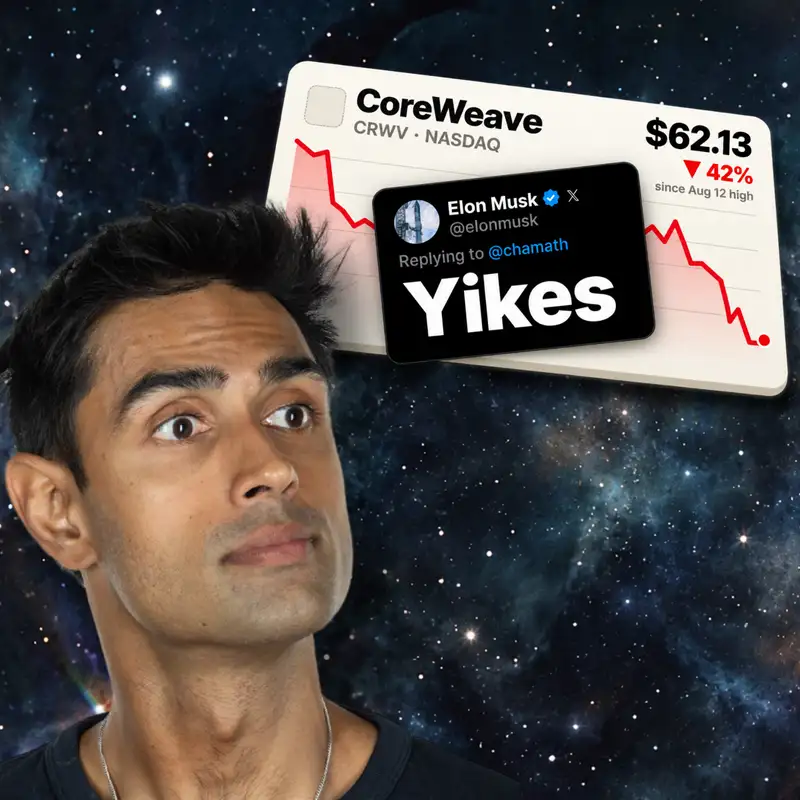
And then Elon Musk replied to this tweet, yikes, five letters,
and it crushed the entire stock market.
By the end of the week, CoreWeave was down 25%. And then over the following
days, other semiconductor or just AI stocks in general brought the entire market
down because the market is...
Essentially propped up by a lot of AI stocks right now. And it led to around
$1.6 trillion being wiped out over semiconductor AI stocks specifically,
which is the most part of the capex bubble.
And I find this weird because it was even affecting stocks that weren't directly
associated with CoreWeave. I understand if it affected other neoclouds or cloud
service providers for AI, but it started hitting TSMC, who reported their best quarter in history.
That means that there wasn't a single quarter prior to that,
that TSMC hadn't beaten. And TSMC basically makes or produces the chips that
NVIDIA builds and designs.
So they're at a core fundamental piece of this entire market,
of this entire AI infrastructure build out, and their stock still fell.
So this seemed to be kind of a broader drawdown based off of sentiment that
people were, I guess, predicting about this AI CapEx infrastructure build.
Now, listen, we've made episodes before talking about how the rise of spending
from very few companies, honestly, it's around eight companies, Amazon, Google, Meta,
Microsoft, were spending upwards of, I think, $550 billion just this year alone.
And they're planning to spend upwards of $1 trillion for next year.
And for the first time ever, these companies are breaching into the red, negative cash flow.
Listen, we're talking about companies here that have hundreds of billions of
dollars on their cash balance sheet.
And now that's depleted to zero, such to the point that they need to borrow
money. Now, it makes sense that these companies are earning money in many other
different ways that aren't necessarily tied to AI. So they are able to fund
these different kinds of things.
But smaller companies like CoreWeave, like Nebius, like IREN,
who are contingent on this AI CapEx bubble still inflating, rely a lot on the
financing, which is why we might be seeing worries around this yield thing.
So it caused people to panic, understandably. And then finally,
on Monday, people started to relax. CoreWeave.
Burst up 6.9%, I believe, and Goldman rated CoreWeave a buy.
So the question we need to unpack here is, what the hell just happened?
And two, is there any substance behind the market drawdown? And what does that
tell us about the wider fears around AI in the bubble?
Listen, it's no mystery that people are very excited and optimistic,
potentially over-investing, whether we are too levered up and there's a private
credit bubble, to Chamath's point last week.
So let me try and unpack what's happening here.
Think of CoreWeave as a landlord. They purchased 51 apartments.
The apartments in this case are data centers. They're very expensive, very cost intensive.
So they borrowed money to be able to purchase these apartments.
And then what they've done is they've leased these apartments out for use for
the likes of Microsoft, Meta, people who are paying them rent effectively.
Now, for them to be able to borrow this money is the equivalent of taking out
an expensive mortgage or just a mortgage in general.
And the issue is, more recently, mortgage payments or the mortgage rates have
skyrocketed to the point where they've had to pay back $640 million of the recent
quarter, the last three months.
Now, in CoreWeave's defense, they've been making money on the renting out.
They made around $2.6 billion in the last quarter.
And technically, they should be profitable after costs. I think after OPEX and
CAPEX costs, they're down to about $1.5 billion.
But now they have to pay near or almost more than half of that back to these mortgage payments.
And next year, they're projected to pay $300 million more on top of that for
the mortgage rates, bringing them to $900 million.
So with all things balanced out on their books, they actually are down $626 million.
Not great. And listen, this could be something that CoreWeave could deal with
if this was a static number, but they're actually ramping up spending.
CoreWeave is set to spend around $6.4 billion on new data centers over the next three months.
So you can imagine the gap is widening behind the debt that they have to pay
back and the money that they're actually spending for the future versus the
money that they're actually making.
Now their debt has risen to about $35 billion and $10 billion of those dollars
needs to be paid back in the next 15 months. So,
and they only have $5.5 billion of cash on their balance sheet.
So the question is obvious to everyone. How on earth do they plan to pay any of this back in time?
And when someone ran the stats online, it basically looked like a coin flip
as to whether CoreWeave was going to default over the next three years.
55%. Now, Chamath's point wasn't necessarily sell all your entire stock in CoreWeave
and the entire AM market.
He was just pointing out a trend that could potentially become very cumbersome
or worrying if it continued to grow.
He pointed out that two months ago, the mortgage payment or the mortgage rate
that CoreWeave had to pay back on their debt was only 10%.
And since those eight weeks have happened, it's risen another 5% and it's projected
to rise another 5% and it may keep on going to the point where CoreWeave needs
to default on some of their loans.
He's just looking at where the smart money is thinking about CoreWeave,
Neoclouds and just borrowing in general for AI expenditure.
He basically says that, listen, the bond yields basically are the effective
rate that the insurance market will be willing to pay or price the debt that CoreWeave is taking on.
And so right now it's 15%. Two months ago, it was 10%.
And his idea is basically the insurance providers, the people who are lending
them the money, the people who are going to get paid back the money first when
CoreWeave has the money,
are pricing this as a very expensive risk to the point where they think that
CoreWeave at a coin toss might default over the next three to five years.
And he's saying the aggregate of CoreWeave's debt balance sheet,
the money that they have on their balance sheet, which is around $5.5 billion.
And then the rates that are increasing collectively might end up becoming a
problem for them, especially as CoreWeave is aggressively spending more and
more money to acquire more data centers.
It's worth pointing out that I think two to three years ago, they only had
three data centers and now they have 51 data centers and they're planning to
spend six and a half billion dollars over the next three months so he's pointing
out that like hey listen we might need to slow down you might need to cut your
costs a little bit we're not saying throw in the towel by any means
but slow the hell down or we're going to end up in a dot-com type
bubble that is definitely going to burst at least what CoreWeave and some of
the neoclouds are doing so i thought about this a bit and Chamath's point definitely
stands and i think he's right to kind of wave the flag and, you know, warn people of this.
But I think the market may have potentially overreacted. It's funny because
they had the CoreWeave CEO come on to the All In podcast, I think like three
weeks ago, I remember watching it.
And I remember him explicitly describing how the financing of these different deals work.
So let's say, for example, CoreWeave signed a major deal, multi-billion dollar
deal with Microsoft, which they did a few months ago, and we reported on it
on this show and he basically said.
He built something called a box obviously this is metaphorical but he treats it as a box
and in that box the first round of financing comes from the customer themselves so
CoreWeave signs what's known as a long-term agreement which is essentially
a promise that microsoft in this instance will need to spend a certain amount or all of the.
Even if they don't take the compute off of CoreWeave's hands.
So in the event that Microsoft didn't want to take the compute or they didn't
need the compute, they would still need to pay for it.
The entire point here is that each deal that CoreWeave signs is locked in its own box.
And the money that goes towards paying for the GPUs, the CapEx,
the power, the electricity, the land that is needed to basically make this data
center come alive and serve that actual customer
is paid for by that customer. It comes in that rental payment.
And then only after that does CoreWeave actually take any money.
But it gets even better. The CoreWeave founder also spoke about the revenue backlog.
They have around $129 billion, last time I checked, which was yesterday,
over the next couple of years to 2032.
So that's a lot of money, but also 98% of it is technically or contractually.
Uncancellable, which means that they've signed pretty crazy,
lengthy, long-term agreements with these big companies who have presumably financed
on much better ratings because, you know, they are Microsoft,
they are Google, they are Meta.
From CoreWeave's perspective, they have money in the bag and it may not be in
the bag right now, but contractually they do have it.
But let's also assume that, you know, even all of those things are in jeopardy.
They have the bank of NVIDIA backstopping them. Jensen Huang and NVIDIA recently
said that any capacity that goes unfilled for CoreWeave specifically, they will fill.
They will pay for up until 2032. NVIDIA is also a major or big investor in CoreWeave.
Jensen Tuong, after this entire media blitz happened over the last couple of
days, came out and said, I've looked at CoreWeave's books.
I know the founders. I know exactly the deals that they're financed.
And trust me, they're good.
They're better than ever. And he quoted the 112% revenue gain that they had
despite the stock dumping.
So while it might seem analogous to the 2008 financial crisis,
which, you know, you had credit default sops back then, it's a similar instrument
to what we're seeing with the bonds and the insurance market right here.
It's easy to make it seem like an apples to apples comparison,
but my take is that it's simply not.
In this event, yeah, we do see massive scaling and slightly levered financing,
but it's nowhere near the point that we had at the dotcom bubble burst.
It's certainly something that we should keep an eye on. And I think Chamath
calling out the rates increasing is definitely a worthy thing to do.
But I think the market's reaction is...
I guess, overreacted to the entire thing. And the other near cloud founders
actually backed CoreWeave up.
You had the founder of IREN and Nebius, and I think I saw Nscale also come online
and basically say or echo something similar to what CoreWeave said around their whole box.
They said, listen, we're not taking on massive amounts of debt and spreading
that around to any and every customer. We silo it in these boxes.
And the tenants, in this case, whoever they sign a deal with,
Anthropic, OpenAI, whoever, are the ones that pay for the majority of the CapEx
first. So we are actually actively paying back these different loans.
And the future guarantee of these $129 billion worth of revenue backlog,
in CoreWeave's case, is going to do the same thing.
In fact, Nscale specifically, they signed a $45 billion deal with Anthropic
earlier this year, because Anthropic obviously needs a lot more compute to train
and influence their clawed models ahead of their Blockbuster IPO.
So yesterday, they announced another $45 billion deal with Nscale.
So if these neoclouds were truly in jeopardy, putting CoreWeave aside and just
looking at neoclouds in general, would they still be signing these deals?
Probably not. But then again, Anthropic has also committed to half a trillion
dollars worth of capex spend over the next three to five years.
And their revenue has slowed down to about 45% quarter of a quarter.
The quarter before that was 110%.
So, you know, doomers or negative speculators are basically saying that maybe
their revenue is slowing down and this could culminate in the bubble bursting.
I personally have no idea. I wish I could look into the financials of all of
these, but this is just generally what the structure of things look like.
OK, so then stepping back from all of this, what's the bull and bear case for
all of this? Is there any actual substance to this drawdown or are we about
to recover? Let's get into it on today's episode brought to you by Qualcomm.
Let's start with the bear case, because it was the first thing that I listed down here.
So number one, can CoreWeave actually pay back their debt? They're burning around
$5.7 billion per quarter.
We don't know the structure of the contracts. So how soon they're going to get
some money from that $129 billion backlog, whether it's in enough time to pay all of this back.
And then also, we don't know where the bond rates are going to be.
If two months ago, they were at 10% and now they're at 15%, they could be at
20%, God forbid, 25% in the next two months, there's a lot of factors that could be at risk here.
But also, CoreWeave has a customer concentration risk.
I looked into the reports or the finances from their previous quarterly earnings,
and I saw that three customers account for 36%, 22%, and 12% respectively for their revenue backlog.
That is a huge customer concentration risk. And listen, it's not weird to see
these kinds of things. These are large-scale enterprise contracts.
Anthropic, even though they're dealing with a lot of consumer appetite through
subscription revenue are also making most of their money through enterprise.
So is OpenAI, by the way. I think their enterprise revenue recently flipped
consumer revenue. The point is, enterprise contracts are meant to be concentrated and large.
Though in CoreWeave's case, relatively to how much money that they're making.
It's a large chunk of their balance sheet. And then another point is something
that Ben Horowitz brought up last week, which was this,
is kind of giving us feelings of the 1999 bandwidth expansion where everyone
in telecoms was just buying up phone lines, building up these internet lines,
and putting a lot of money into the piping for this entire internet era.
And they ended up becoming a massive oversupply and that entire thing crashed,
which is what led to the dot-com burst. I don't quite think that this is the
same thing here because of one major constraint.
We can't bring compute online quick enough. We are constrained by power, land, power, and shell.
We're constrained by electricity. We're constrained by physical atoms.
And honestly, I'm tempted to make another episode about this individually because
it highlights a really good investment opportunity, but also what is holding
the AI capex spend out back.
Weirdly, this might have a second effect where it ends up being a really good
thing for the build out so that we don't build too fast like we did back in the telecom era.
And then the final point I'll make is that the bank of NVIDIA is a precarious thing.
I get that they're the most valuable company in the world, but backstopping
all these different deals, which are probably worth north of $1.1 trillion is
potentially a dangerous thing.
Like a 25% decline in Nvidia stock could cause an entire catastrophe.
Okay, so then what's the bull case? Well, the first one is Andy Jassy,
CEO of Amazon, in his comment last week, which basically implied,
or actually it didn't imply, it stated that demand had exceeded beyond 2028.
Now, that is part of a wider trend that we're seeing across hyperscalers and
just AI CapEx compared to the dot-com era where there's actually demand for
these things. People are willing to put up and pay a lot of money for the supply
that is being created here.
Back in the dot-com era, no one wanted to buy the thing. There wasn't that much demand.
The difference here is not only are they willing to pay for it,
but they're willing to pay a premium for it.
GPU prices on the secondary market are at the highest that they've ever been. GPUs that.
Cost a certain amount when they debuted, when they first got created,
are now worth twice that despite being five to 10 years older. Think about that.
An old janky piece of metal is worth twice more than when it was originally debuted.
So the idea here is that demand is off the charts. People are paying for these things.
But of course, the question then becomes, will this be sustainable over time?
The other bull case is people are mistakenly calling out CoreWeave's financing
to be specifically siloed to them, but that's not necessarily true.
You should look at the customers who are paying them the money in the first place.
Microsoft, Meta, Google, they are the ones that are getting really attractive
mortgage rates, if we want to continue the analogy, on all of these different
deals. So they are able to finance and provide the money that is necessary for all these things.
I find it funny that Elon Musk created this or was partly responsible for creating
this market downturn by responding, yikes, to Chamath's original tweet, where,
literally yesterday he posted a tweet saying, my conversations with neoclouds
are the most difficult that they've ever been because no one wants to sell me compute.
Even though they have these GPUs, they've already pre-sold it at a much higher
premium rate to all these other companies.
So there's huge market demand even for the biggest players that want to purchase this at a premium.
And the final thing I'll say is the power constraint, the bottleneck that I
referenced earlier in this episode, is a real thing and might actually end up
playing in CoreWeave and the entire market's favor.
As much as people want to spend money, as much as people want to create GPUs,
computes, data centers, and sell that for as much money as they can,
they physically can't because we don't have the technical know-how,
the land, the leasing, the regulations in our favor to build as fast as we want
to. The dot-com era, we could.
Right now in the AI era, CapEx Builder, right as it stands right now, we cannot.
There's too much bloat, there's too much regulatory red tape,
And there's too much, honestly, humans and human atoms that need to be moved
that hasn't been galvanized at this point.
It's the point that Gavin Baker frequently makes in all of his posts about this
stuff. And he's one of the most knowledgeable folk in AI capex spend out in general.
So given this entire summary, the CoreWeave thing was a necessary warning signal to make people aware.
But I think the market downturn, people's reaction to this entire thing is overdrawn.
And that's probably why we're seeing CoreWeave starting to recover,
the markets start to bottom.
And I think that it probably resonates with people's.
Kind of concerned with seeing such a major explosion of investment.
I think I saw a stat somewhere where 75% of all general VC investment this year has been on AI.
We've never seen that happen for any other technology explosion,
even for blockchain and crypto over the last couple of years, even with biotech.
And now with AI consuming pretty much anything and everything,
it's understandable that people are potentially concerned about overspending here.
And I think we should keep honestly calling out the warning signals so that
we can keep ourselves accountable for this entire thing
so yeah i hope you enjoyed this episode i hope some of this made sense to you
i was trying to unpack all of this over the weekend and i wanted to create a
compelling episode that you know you the audience could actually understand
so let me know if this was helpful or if i missed anything let me know
for those of you who have been listening to our episodes especially with the
new format of the show we are tweaking different things as you can tell this
is a different camera angle we're trying to make it more personal try and recreate
kind of the bedroom aspect that we had in the old show.
And yeah, I hope you're enjoying the show. If you like this episode and you
want to share it with a friend, please go ahead and do so.
If you have not subscribed to our channels, wherever you're listening to it,
or haven't given us a rating or left us a comment, please do so.
It helps us out massively. Thank you so much for listening, and I'll see you
on the next episode of In The Loop, brought to you by Qualcomm.
Creators and Guests